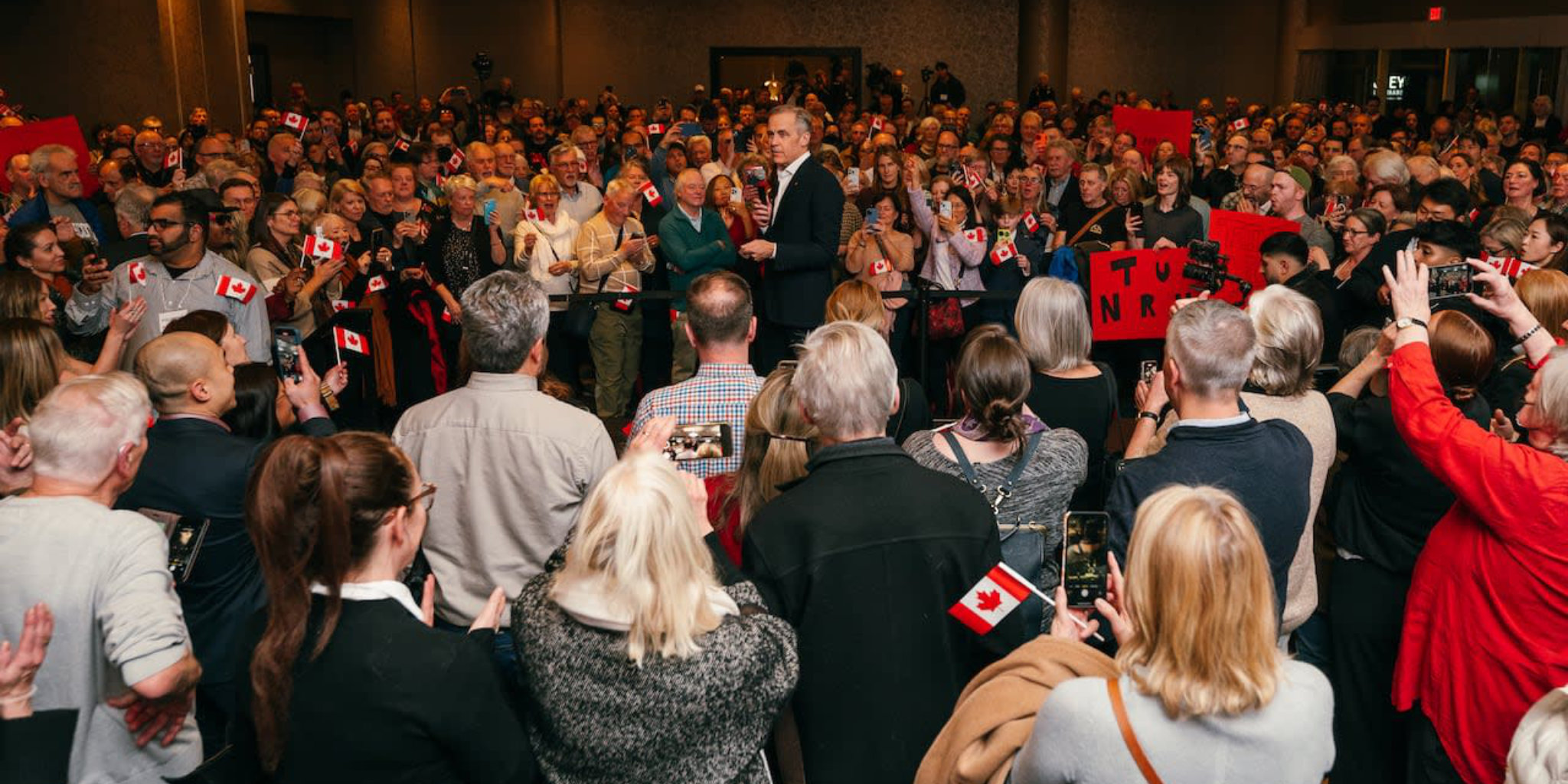
On March 14, Mark Carney was sworn in as Canada’s 24th Prime Minister.
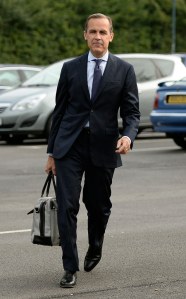
As many commentators have observed, Carney is an “unelected” Prime Minister, in the sense that he doesn’t have a seat in Parliament. Instead, he won the top job by being elected leader of the Liberal Party of Canada.
In other words, about 151,000 party members have just chosen the Prime Minister for a country of 41,000,000.
But who really decides the outcome of a party leadership race? Is it the democratic exercise it’s portrayed to be, or are there other forces involved?
It depends on who you ask—and whether they’re happy with the outcome.
There are four common theories as to who the “prime mover” is in a party leadership race. In this post, I’ll describe each of the theories, then give my opinion on which theory is right, and explain who really chose Mark Carney.
Theory #1: Party Members
The “traditional” explanation is that a leadership race is a healthy exercise in democracy. Rank-and-file party members come together to evaluate the candidates by watching debates, scrutinizing the candidates’ resumes, listening to policy announcements, and so on. Once the candidates have been given an equal opportunity to showcase their abilities and vision, the members express their preferences through the voting process, arriving at a collective decision.
This is the explanation that parties promote. It’s what many members want to believe, and it’s a framing that most media, even when they’re skeptical of some of the details, don’t fundamentally question.
But… is it true? There are some strong arguments that it’s not.
Exhibit A: The results of the Liberal Party’s 2025 leadership race diverge drastically from the preferences that party members expressed in a well-designed February 23 poll by Mainstreet Research. Instead, the voting result looks a lot like the proportion of donations that each candidate had received by February 25:
| Candidate | Polling | Donations | Actual Result |
|---|---|---|---|
| Baylis | 3% | 1% | 3% |
| Carney | 46% | 82% | 87% |
| Freeland | 33% | 7% | 7% |
| Gould | 17% | 10% | 3% |
Vote result is the popular vote, without applying the party’s 100-point weighting system.
Why would members vote in line with fundraising statistics, rather than voting in line with their own stated preferences? If 46% of party members preferred Carney and 33% preferred Freeland, why did Carney receive 87% of the actual votes and Freeland only 7%?
This phenomenon isn’t isolated to this particular race, or even to just the Liberal Party. I’ve projected five leadership races since 2017, across four different parties, and donations have been a reliable predictor every time. So, there’s obviously something at play here other than member’s preferences.
This isn’t the only fact contradicting the idea that leadership races are a fair, democratic contest, with members in the driver’s seat. There are plenty of other contradictions:
- Donations accelerate drastically once a campaign team gets access to the membership list. In other words, most members donate reactively, not proactively.
- Some candidates get featured on talk shows or major podcasts, featured in magazines, or have op-eds published in national papers, while others don’t. The playing field for sharing ideas and building name recognition isn’t democratic at all, and doesn’t seem to be member-driven.
- Campaign teams often include professionals from outside the party in important roles. In other words, team size and capability aren’t driven purely by members volunteering.
- Candidates who appeal to younger members or marginalized groups always seem to underperform on the final vote. In a democratic vote, there should be no difference.
- Candidates are often allowed to use personal money to pay early entry fees, and it’s common to see wealthy candidates who aren’t popular with party members still gaining access to the race.
These contradictions can be explained, but only if we drop the idea that leadership races are a purely democratic exercise with members as the driving force.
Let’s look at a different theory as to who the prime mover might be.

Theory #2: The Candidates
Some people think of a leadership race more like a civil war. Every candidate publicly claims to have the interests of the party and country at heart, but behind the scenes, they’re doing everything in their power to crush their opponents. Whoever can apply the most wealth, connections, and cunning to dominate their opponents will get the job, along with its power and prestige.
Everything else—the party bureaucracy, the contest rules, the debates, the media, and so on—is part of the terrain: something to be used when it’s advantageous, and circumvented when it’s not.
As for the members, they’re just another resource to be exploited for dollars, volunteer hours, and votes. In short, a leadership race is a merciless Darwinian contest.
Sound extreme? Perhaps. Then again, consider all of the ways that candidates can use their personal wealth and connections, along with anti-democratic tactics, to gain an advantage:
- They can build and buy a bigger, more capable campaign team to work the phones and social media every day.
- They can pay part or all of the party’s entry fee themselves, without worrying about early fundraising results.
- They can secure appearances on big-name TV shows and podcasts, or get an op-ed published in a major newspaper.
- They can buy sophisticated database software to track every interaction with members, identify supporters, and “blast” them regularly with mass messages urging them to donate, volunteer, and vote.
- They can pay somebody to ghostwrite a book about their life story or vision, and get that book widely promoted.
- They can dodge high-risk activities, such as optional debates, unscripted Q&A’s, and detailed policy papers, even though it would be more democratic to participate in these activities.
- They can avoid low-return activities, such as campaigning in areas they don’t consider winnable, or interacting with groups that can’t deliver them a lot of votes, even though it would be more democratic to participate in these activities, too.
Everything is about building power to drive the final vote. Whoever has the biggest and most capable team, the most sophisticated database, the biggest and glossiest promotional campaign, and the most streamlined and efficient tactics will overwhelm their opponents through sheer numbers.
It’s unpleasant to imagine things working this way, but there’s undeniably some truth to it. Most importantly, this theory explains why donations consistently predict the outcome of a leadership contest: a campaign team that has the capacity to contact a lot of members for donations also has the capacity to remind a lot of members to vote.
This theory also does a good job of explaining “front-runner behaviour”, like appearing on talk shows while skipping debates. It also nicely explains the presence of wealthy-but-unpopular candidates.
But there’s one problem with the idea that candidates drive everything: the leadership contest isn’t designed or operated by the candidates, but by the party itself. Let’s turn our attention there next.

Theory #3: The Party Elite
Some people insist that the party elites control everything.
The leader may be the public face of the party, but like the proverbial iceberg, there’s a much larger organization operating below the surface. People who will never be household names, occupying both official and informal roles, form an invisible elite that exerts influence through behind-the-scenes conversations, networking, and deal-making.
Long before members make their decision, the party elite has already chosen their preferred winner. However, they can’t simply coronate this person. They need the appearance of an open, democratic contest to give the new leader legitimacy.
To achieve that, they need candidates who appear to be “outsiders”, but who can be kept under strict control. They need a contest that appears to be “open”, but is actually designed to filter out undesirable candidates. Media coverage, donations, and member buy-in are driven by the idea that any outcome is possible, but in reality, the outcome needs to be under strict control.
Does all of this sound a bit too shadowy and conspiratorial?
Take a moment to consider the ways that the party elite can give their preferred candidate an “invisible advantage”:
- Long before a leadership race is called, the elite can begin building name recognition for their preferred candidate, feeding the candidate’s name to the media and advising the candidate on brand-building activities like publishing books, starting their own charitable organization, running in a general election, and so on.
- The preferred candidate can be connected with high-calibre talent and advisors for their leadership campaign team, can be put in touch with high-value donors, and can be introduced to community leaders who can deliver large blocs of votes.
- The rules of the contest can be tailored to fit the preferred candidate by customizing dates, fees, entry requirements, debate format, and so on. Details of the rules can be passed to the preferred candidate well before they’re publicly announced, giving the candidate extra time to prepare.
- During the contest, the scales can be tilted further if necessary. A competitor’s application can be held up on some bureaucratic detail, or even blocked entirely on trumped-up grounds. Information or rumours can be leaked to media outlets desperate for scoops. A respected party figure can give a glowing endorsement for the preferred candidate–and maybe also a dire warning against their main competitor.
Depending on your own political experience, some of this might sound far-fetched, like the stuff of a thriller novel. But I can tell you that every point on the list above is something I’ve either witnessed first-hand through my own experience in party politics, or something that has happened elsewhere in Canadian politics and eventually became public knowledge through media exposure.
So, as objectionable as this cloak-and-dagger stuff may be, it really does happen, and it materially affects the outcome of leadership races.
Fair enough—but do party elites completely control the outcome?
All along, we’ve been assuming that the elite agree amongst themselves as to who the preferred candidate should be. What if they don’t? What if there are two or more factions within the elite, and they oppose each other?
In other words, dirty games are certainly being played, but all of the elites may not be playing on the same team. One of the most well-known instances of party infighting in Canada was the Martin-Chrétien feud, but there have been countless other instances less known to the public.
In reality, competing groups are constantly vying to gain or hold on to control of political parties. Inevitably, outside interests are involved too, which brings us to our final theory.

Theory #4: Big Money
Political parties don’t exist in a vacuum. If party elites can use their resources and connections to influence a leadership race, so can outsiders—and the outsiders who are the best equipped and most motivated to influence politics are big business and wealthy individuals.
Money talks, and there are plenty of people who would tell you that big money is what really drives party leadership races.
Canada has fairly strict laws about giving money directly to candidates, with limits on annual donations and prohibitions on giving through third parties. However, there are plenty of other ways wealthy elites, Canadian or otherwise, can influence a leadership race:
- Much like the party elite, they can connect their preferred candidate with talent for their campaign team, put them in touch with high-value donors, and connect them to public figures and respected people in the business community. Wealthy people are well connected, so the pool of potential donations and talent is vast.
- News media are often willing to print op-eds or open letters from prominent business owners, and these can shift the themes of a leadership race. Sometimes, the business owner might even own a newspaper themselves, and can control its editorial direction.
- Money can be translated into social media influence. Canada has laws controlling political advertising, but there’s an entire shadow industry of influencers, bot farms, and troll farms—often operating from outside Canada—that can be hired to simulate grassroots support, or to push certain talking points.
- Big money can even put the party elite to work on their behalf. Respecting the preferences of big business is one of the ways party elites keep the party viable, so they’re always ready to listen and make sure a business-approved candidate has the advantage. In other words, every internal tool available to the party elite is indirectly available to business owners as well, just by signalling their preferences.
There’s no end to the diverse and creative ways that money can find its way into the right pockets in exchange for promotions and favours. It’s this flexibility, and the sheer amount of money in play, that would allow big business to be the prime mover in leadership races.
But do we have actual evidence these things happen?
Well, we have plenty of evidence that big business interferes in Canadian politics in a general sense. Episodes like the SNC-Lavalin affair, the Airbus affair, and the Pacific Scandal show Canada’s long history of allowing corruption for the sake of business interests.
Given that big businesses are willing to participate in illegal corruption schemes at the highest level of government, why would they be unwilling to influence mere party politics?
For big business, everything is a transaction. All that matters is securing a competitive advantage, and politics is just one of many arenas where this competition plays out. We would be naiive to think that business interests abstain from influencing leadership races–of course they are involved.
But this still leaves us without an answer to our bigger question: which theory is right? Who is the prime mover in party leadership races?
Who’s really the prime mover?
I’m sure it’s obvious at this point that all of these theories are true to a certain degree.
The idea of a “prime mover” is a red herring. Any time an important political decision is being made, everyone affected by that decision will try to influence the outcome, using whatever power is available to them. Leadership races, like any political decision, are a complex system with many actors.
Our four competing theories are really four co-existing sources of influence, all acting at the same time. However, that doesn’t make them all equal, or all equally desirable.
On that note, there are three important observations we should make:
- The only democratic influence among the four is the party membership. Candidate wealth and connections, party elites, and big business are all anti-democratic influences. Earlier, I implied that it would be naiive to think leadership races are purely democratic. But that doesn’t mean democratic leadership races are undesirable; rather, it’s an ideal that most of us support. For this reason, the status quo should concern us.
- The three anti-democratic influences are, in reality, all derived from wealth. To be a dominant candidate, you need to use personal wealth. To become part of the party elite, you need to either have wealth yourself, or be good at obeying wealth. So, despite the fact that I’ve referred to a leadership race as a complex system, the central conflict within that system has two well-defined poles: democracy vs. money.
- Many of us aren’t too concerned with what happens inside political parties. However, much of what’s been said in this post holds true for general elections. Many of the same influence methods can be applied, and as a result, money drives election outcomes in Canada. Regardless of what we think of political parties, that concerns us all.
The question of how to tilt leadership races and general elections away from the influence of money, and toward real democracy, is a subject for another post. For today, it’s time to wrap up by answering the question we started with:
Who really chose Mark Carney?
In the 2025 Liberal Party leadership race, we can see all four influences in play in the selection of Mark Carney.
- Obviously, he attracted genuine member support, as evidenced by the Mainstreet Research poll. Carney has occupied roles of serious responsibility in his career, and it’s no surprise that party members would consider him a viable choice as leader.
- However, Carney’s campaign team also played a role. Upon gaining access to the membership list, Carney’s donations accelerated by a factor of about 20, a much stronger acceleration than his competitors, indicating a more efficient team. Had Carney’s team only had the capacity of Freeland’s or Gould’s, his final vote total might have been closer to 65% rather than 87%. (Carney’s interview with Jon Stewart prior to the start of the leadership race was also suggestive of a carefully planned and executed campaign.)
- It also appears that Carney was acceptable to the party elite. His name had been haunting the Liberal party for years without any apparent push-back. We also know that Trudeau had attempted to replace Freeland with Carney as Finance Minister shortly before her resignation. During the leadership race, Carney attracted numerous endorsements from sitting MP’s, receiving five endorsements for every two that Freeland received, a much higher ratio than their comparative support among party members.
- Finally, there are clear reasons to see Carney as the most appealing candidate for big business and wealthy Canadians. His background working at investment bank Goldman Sachs certainly wouldn’t make him unpalatable to big money. Furthermore, his most prominent campaign promise was the elimination of the carbon tax, a policy which moved billions of dollars from the wealthiest 20% of Canadians to the remaining 80%, while dampening investment in oil and gas—two issues that are certainly on the radar of wealthy Canadian investors.
Altogether, if we take Carney’s “natural” support to be the 46% shown in the Mainstreet poll, we’re left with the conclusion that his campaign team, Liberal party elites, and wealthy interests combined to contribute an additional 31% to his final vote total.
If we further consider the efforts of all these actors prior to the Mainstreet poll, and prior even to the leadership race being announced, it’s hard to say whether party members or other actors played the biggest role in choosing Carney as leader.
In other words, a country of 41,000,000 did not have its Prime Minister chosen by 151,000 party members. In all likelihood, the choice was made by even fewer people than that.
With an election coming on April 28th, the Liberals may not be the only party to hold a leadership race this year. When the next one comes, who will have the most influence over the result, and what decisions will that new leader make that affect your future?
If you enjoyed this post, please share it with your friends and contacts. Later this week, I’ll have a shorter post exploring an early projection for the 2025 election.
 Saul Bottcher
Leave a comment