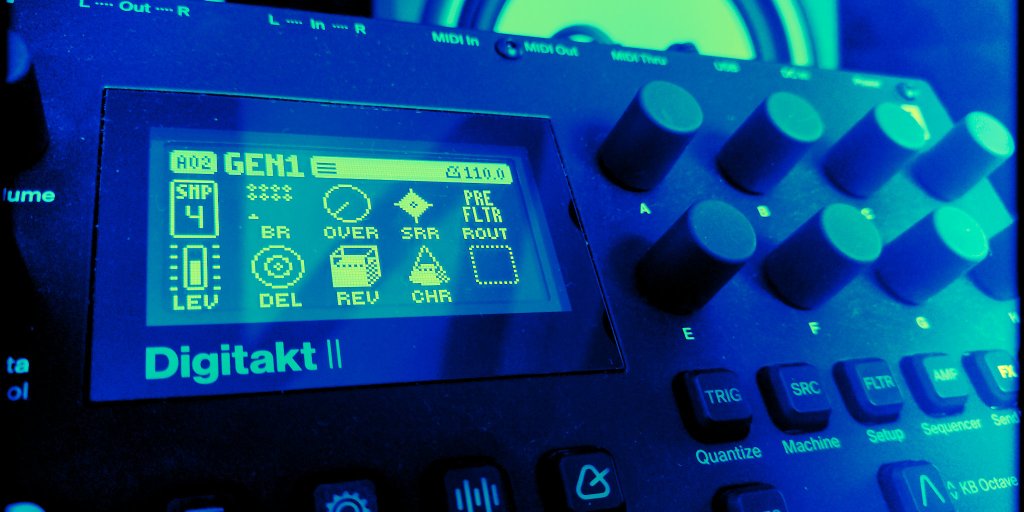
Prompt: Generative, Digitakt II only, basic waveforms only
Process:
For this sketch I wanted to use the Digitakt II to create a piece of generative music. (The title of the sketch refers to the overlapping term, stochastic music.) To keep the focus on the generated melodies and harmonies, I restricted myself to using only basic waveforms (sawtooth, sine, white noise), and didn’t include any percussion.
Composing a generative piece is a very different process and requires a different mindset to “normal” composition. Instead of writing and refining a melody or chord progression to achieve a certain effect, you’re instead writing rules, observing how those rules play out, and refining them to change the possible outcomes. It’s both more analytical and more abstract at the same time.
Of course, whether a piece of music is “generative” is not a yes/no attribute, but a spectrum. A completely random system would produce unlistenable chaos, so all generative music ultimately contains a certain degree of intent by the composer. The question is rather which elements are fixed or randomized, and what effect is produced.
In this piece, the broad structure is fixed. Seven melodic tracks are introduced one at a time, then (after a brief exploration) removed again in reverse order. If I recorded the piece multiple times, this structure would always be the same, and the total duration of the piece wouldn’t change. What would change are the individual notes and harmonies that occur within that simple growing-receding structure.
The individual melodic tracks all draw their notes from the C minor scale, but with different restrictions. The bass returns to a low C every 8 bars, and other tracks use a subset of the scale, so the overall harmonies that occur tend to have a particular character.
Rhythmically, each track is based on a different note length (half, quarter, eighth, etc), with small embellishments occuring randomly. The slowest tracks are introduced first, the fastest last, which reinforces the growing-receding structure of the piece.
Timbrally, each track is also given its own identity as an “instrument” (remember, they’re really just sawtooth or sine waves) through cyclic or random variations in filtering and panning, along with fixed differences in filter, delay/reverb, chorus, and so on. As a result, one track sounds like a bass, another like a sort of frantic bagpipe, another like a whale call.
In total I worked on this for about a day. At the start of the process, I spent time thinking about the scale and restrictions I would use; everything after that was basically a process of experimentation and proceeded fairly quickly. I’m happy with the results, though I also have an urge to “fix” certain notes, and also a desire to hear a version of this piece with more sophisticated instrumentation.
(Aside: I think generative music can be seen not just as a type of music, but also as a possible step in a composing process. Some writers of fiction don’t allow themselves to stop and edit while writing their first draft, because editing disrupts your flow and pushes your mind into an analytical mode. In a similar way, creating a generative piece of music makes it impossible to fiddle with individual notes, forcing you to focus on broader ideas of mode/scale, texture, and structure.
A composer could therefore choose to see their generative piece as a finished work in its own right, or as a starting point and inspiration to be adapted to a fixed composition afterward.)
 Saul Bottcher
Leave a comment