Welcome to The Unspoken News, a new feature where we’ll be looking at current events from angles that the major news sites have missed. Whether it’s a question that should’ve been asked, or a connection that should’ve been made, we’ll cover it here.
Mark Carney and Donald Trump have been in the news constantly these past few weeks, as people in Canada wait nervously for a trade deal to stabilize Canadian industries and jobs. With yet another round of tariffs announced by the Trump administration—this time it’s 50% on copper and a general tariff of 35%—the merry-go-round shows no signs of stopping. Carney, meanwhile, has started to manage expectations, preparing the public for a half-deal that will reduce tariffs but not eliminate them.
In the middle of all of this, there’s another story that will affect your daily life just as much as the tariffs, but hasn’t received as much attention. I’m talking about Carney’s review of public spending, or as I suggest you think of it, DOGE North.
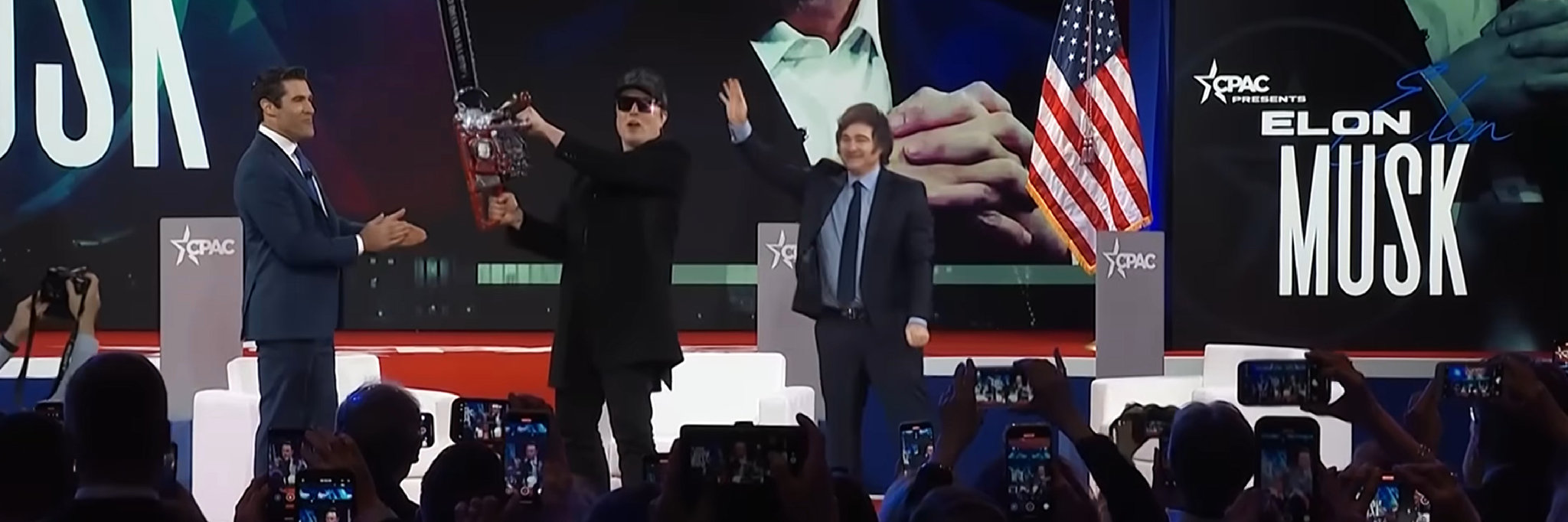
I know, I know, on the surface Carney’s spending review looks completely different from DOGE. When you compare it to Elon Musk swinging a chainsaw at a rally, his laughable promise of two trillion dollars of cuts, and the childish name derived from a meme coin, the Canadian effort comes across as profoundly more serious.
But let me suggest that below the surface, there isn’t much difference at all.
A façade of seriousness
The seeds of the Department of Government Efficiency (DOGE) were planted at a Trump rally in October 2024, when Elon Musk promised to cut “at least two trillion” dollars from the U.S. budget. (Unfortunately, the U.S. budget only contains $1.7 trillion of discretionary spending. Oops!) Musk later lowered his estimate to one trillion dollars, which would still have been mathematically impossible without cuts to defence spending. By April of 2025, reality had set in, and DOGE was claiming a much-lower $150 billion in cuts, with even that figure being disputed by groups across the political spectrum.
By contrast, Carney’s boringly-named “comprehensive expenditure review” was launched without a chainsaw or meme coin in sight. Finance Minister François-Philippe Champagne simply sent letters to cabinet ministers asking them to come up with “ambitious savings proposals”. In place of Musk’s bombastic promises, Champagne’s letter requested phased-in cuts of 7.5% for the coming 2026-27 budget, then an additional 2.5% the next year, and another 5% in 2028-29, for a total of 15% to be cut from each ministry.
What a difference! This is the sort of quiet professionalism Canadians pride themselves on, right?
Here’s the thing though: all of these numbers, both the DOGE promises and the Canadian targets, are completely made up. The only difference is how smoothly Carney and Champagne present their made-up numbers, compared to the brash and unpolished Musk.
For example, take a look at this awkward video posted to Musk’s social network, where he struggles to give a target for the number of U.S. Federal Agencies that should exist. It takes him a full forty seconds to come up with the obviously arbitrary target of ninety-nine. It’s clear from his stumbling monologue that Musk has no idea which agencies actually exist, what any of them do, where any overlaps do or don’t exist, or which agencies (if any) could or should be cut. He’s simply picking the number ninety-nine because he thinks it sounds right.
But are Carney and Champagne any different? Champagne was politically savvy enough to put his targets in an internal letter instead of a public speech, and to refer questions to his director of communications instead of doing an interview with Tucker Carlson. But as far as justifications go, the Canadian public has been given nothing more than Musk gave in his interview—no outline of the alleged waste, no explanation why the target is 15% specifically, no explanation as to why this target would apply equally to every ministry, and no explanation as to why the 15% should specifically be phased-in over three years at 7.5%, 2.5%, and 5%.
This looks a lot like the time-honoured management tactic of setting an arbitrary target, then expecting other people to do your homework for you. If Carney was aware of specific, significant waste, this exercise wouldn’t be necessary. He could simply announce he’s going to cut program A or department B, and justify that choice. But by promising to make cuts without even knowing which cuts might be possible, he’s no different than Musk.
Now, I understand this accusation will be a little hard for some people to swallow. After all, it was only a few months ago that millions of voters took a look at Trump’s threats of annexation and decided that Carney, with his image of competence, steadiness, and professionalism, was the saviour the country needed. Nobody really wants to contemplate the possibility that this spending review might be half-baked.
There are additional clues, though. Minister Champagne has asked each Ministry to identify three budget priorities, then explain how they’ll achieve those priorities using existing resources. But if they’re using existing resources, then Carney isn’t making any tough decisions about priorities, is he? It’s all being offloaded to the Ministers, to figure it out within the arbitrary boundary of a 15% spending cut.
Similarly, Carney has promised to avoid public service layoffs by relying on attrition. Michael Wernick, the former clerk of the Privy Council (i.e., head of the public service), has said that attrition “doesn’t make any sense as a management strategy,” because you give up control over which positions remain filled and which don’t. But again, this offloads any tough decisions.
All of this has the odor of a government that only has ‘concepts of a plan’—or perhaps, a government that’s more concerned with the optics of making “bold moves” than it is with making the right moves.

How damaging could it be?
The cuts proposed by Trump’s DOGE to date are staggering. The list includes 67,000 layoffs, plus cuts to after-school programs, Medicaid, food assistance, HIV/AIDS relief, diversity initiatives, volunteer work programs, medical research, public broadcasting, universities, climate research, the US postal service, EV charging infrastructure, United Nations funding, foreign aid, the IRS, consumer protection, environmental protection, gun control, indigenous libraries, national parks, the department of labor, and NASA and its scientific research. [Sources: 1, 2.]
Altogether, it’s a shocking assault on almost every facet of daily life for the average American. Most Canadians could never imagine something like that happening here.
But consider that DOGE’s $150 billion of proposed cuts represents about 9% of the total discretionary spending in the U.S. budget, while Carney’s target is 15%!
Economist David Macdonald of the Canadian Centre for Policy Alternatives has calculated that, if you exclude Canada’s Ministry of Defense, which is getting a budget increase, then Carney’s target will actually translate to a 24% cut of non-military spending. The DOGE cuts, if you exclude the Department of Defense, only amount to 16% of non-military discretionary spending.
In other words, Carney intends to cut up to 50% deeper than DOGE. It’s worth re-reading the list of DOGE cuts above and trying to imagine something 50% worse than that.
Macdonald’s report points out that these would be the “worst spending cuts in modern history”, deeper than the cuts made by either Stephen Harper (10%) or Paul Martin (18.9%). Attrition would not be nearly enough to meet the target, so the cuts would need to involve “across-the-board job losses and major service reductions”—despite Carney’s election promise not to cut the public service. In an interview with the Ottawa Citizen, Macdonald’s examples of reduced service included “calling [the] CRA and nobody picks up the phone, [or] trying to get a passport and there’s no one there to renew it”.
(Earlier in June, Canada’s Parliamentary Budget Officer, Yves Giroux, gave a similar evaluation of Carney’s budget plans, stating that they would require “severe cuts to the public service”.)
Now, there’s a talking point making the rounds that the public service grew by more than 40% in absolute number of employees under the Trudeau government—the implication being that there’s plenty of room to cut. But this is a dishonest use of statistics, because it ignores three important reasons the public service would be expected to grow under Trudeau: the population of Canada grew by 17%, Trudeau was reversing the 10% cuts made by the preceding Harper government, and new programs (such as dental care and pharmacare) were introduced and needed to be administered.
A more honest comparison would look at the ratio between the public service and the Canadian population, using a start point before Harper’s aggressive cuts. For example, from 2010 to 2023, the Canadian population has grown to 1.17 times its starting size, while the public service has grown to 1.26 times its starting size. Even if we ignore the administrative needs of new programs, it would still take only a 7.6% cut to bring the size of the public service back in line with the population.
That hypothetical 7.6% cut is less than a third of the 24% cut to the public service calculated by Macdonald. So, the claim from Champagne’s office that this is a “rebalancing” of the public service, as if it were a return to earlier staffing levels, simply isn’t true. Carney’s proposed cut is much deeper than that.

What’s really going on?
Even as other Ministries will strain to find Carney’s 15% savings, our military spending is set to increase drastically.
That’s because Carney has committed Canada to a massive military buildup over the next decade, increasing spending from 1.3% of GDP to a new NATO target of 5% of GDP—or in other words, an increase of nearly four times. In dollar terms, this will mean spending about $150 billion more, every single year, on military purchases, despite the fact that total government spending in Canada is only about $520 billion to begin with.
Major media have reported on Carney’s spending review and military buildup as if they’re two separate decisions, when really they’re two halves of the same decision. When you cut spending in one area while increasing it in another, that’s a shift in spending priorities. What Carney is really proposing is a transfer of $30 billion from public services to military spending, followed by an additional military spending boost of $120 billion.
Let’s recap: The spending review isn’t about eliminating the deficit, because you can’t eliminate a deficit of $55 billion by increasing spending by $120 billion. And the spending review isn’t about returning the public service to its former size, because the planned cut of 24% is more than triple the 7.6% reduction that would be needed for that purpose. When you look past the smokescreen, this is about funding the 5% NATO target, plain and simple.
And let’s keep in mind that the 5% target was instigated by Donald Trump, the same President who calculates tariffs using a made-up equation, and who has repeatedly threatened to annex Canada. If Mark Carney’s campaign slogan had been “I’ll cut $30 billion from public services to appease Donald Trump”, I’m not sure he would’ve received quite as many votes.
Sure, Carney has acknowledged people’s patriotism by claiming that Canada should stop sending $0.75 per dollar of military spending to American military firms. But realistically, where is this additional $150 billion of spending going to go? As of today, we’re still on course to buy eighty-eight exorbitantly-priced American fighter jets, we’re writing bid requirements for $100 million of nightvision goggles that eliminate all the non-American bidders, and we’re still considering joining the worthless Golden Dome missile defence system.
And yes, we may have entered the ReArm Europe program, but no specific financial commitment has been announced. It may be as little as a few billion dollars, who knows? Meanwhile, we know for certain that the price tag on the F-35 fighters is $28 billion, and for the Golden Dome, $61 billion.
In short, Canada’s increased military spending is corporate America’s profit.
When you think about it, Carney’s planned cuts are a double slap to the face for average people in Canada. The first slap: all the efforts people have made to resist Trump’s aggression—cancelling trips, buying Canadian, and so on—will be completely wiped out by the fat cheques the government is about to write for American military hardware. The second slap: those same people will be asked to shoulder a massive loss of public services, at a time when inequality in Canada has hit a record high and those services are needed more than ever.
No matter how many speeches Carney makes about the “new realities” of a “dangerous world”, voters didn’t give him a mandate for any of this. In fact, voters wanted the opposite—their top priorities were supporting people in their daily lives and resisting Trump’s aggression.
Canada’s ambassador to the UN, Bob Rae, recently compared the Golden Dome to a “protection racket“. With this massive spending shift, Carney is starting to look less like the poor shop owner being shaken down by that protection racket, and more like one of the mobsters.
 Saul Bottcher
Leave a comment