
(Disclosure: I am not an NDP member, nor am I supporting any candidate in the leadership race. Parts of this post were edited on 24 March 2026 to improve clarity.)
One of the responsibilities we have, if we want to live in a real democracy, is not to be fooled by quasi-democracy: political systems that provide an illusion of choice and participation, but in reality exclude people and are driven by elite interests.
For example, in the Liberal leadership race earlier this year, the final vote didn’t match the will of party members, confirming that other forces were in play.
Now the NDP leadership race has begun, and (despite the party name) this contest will not be democratic either. Yes, it’s true that all members will have the right to participate in a final vote. But before members even see the ballots, their options will have been curtailed by contest rules that favour wealthy campaigns and disenfranchise marginalized members.
In this post, I’ll explain how the entry fee system is more than just a “barrier to entry”, and in fact has many hidden anti-democratic effects.
The entry fee system: inequality at work
To enter the race, each candidate must fundraise an entry fee of $100,000. The fee is payable in four instalments, with the first $25,000 due when the candidate applies.
The first problem is, supporters of different candidates have different levels of disposable income. Take a look at these fundraising statistics from the 2017 NDP leadership race:
| Candidate | Dollars raised | Donors | $ per donor | Donors to reach $100,000 |
|---|---|---|---|---|
| ANGUS, Charlie | $476,065.07 | 4936 | $96.45 | 1037 |
| ASHTON, Niki | $297,433.13 | 3941 | $75.47 | 1325 |
| CARON, Guy | $246,304.08 | 1863 | $132.20 | 756 |
| SINGH, Jagmeet | $924,902.64 | 6484 | $142.64 | 701 |
| total | $1,944,704.92 | 17,224 | $112.90 | 886 |
In the 2017 leadership race, the average donation to Jagmeet Singh had double the dollar value of the average donation to Niki Ashton. (Many supporters of Ashton belonged to groups with less disposable income, such as students.)
Let’s assume two similar candidates were running in the 2026 race. “Candidate S” would need 701 donors to raise the $100,000 entry fee, while “Candidate A” would need 1,325 donors. In effect, when deciding which candidates should be allowed on the ballot, the endorsement of some members is worth more than the endorsement of others. (And even if both candidates ultimately succeeded at raising the fee, “Candidate S” would be confirmed by the party much sooner, so an advantage still exists.)
We don’t yet know the roster of candidates for the 2026 race, but there will always be a “Candidate S” and a “Candidate A” as long as income inequality continues to exist. In practical terms, the message to candidates is: de-prioritize young members, de-prioritize members of marginalized groups, and focus on those wealthy donors if you want to get in the door!
It gets worse though: candidates are allowed to pay the first $25,000 of the fee from their personal funds, and to make loans to their own campaigns. A wealthy candidate could buy their way into the debates—without having raised a single dollar from NDP members! By contrast, a grassroots candidate would need to fundraise that $25,000 entirely from members in the same time frame.
The worst part of all this is that the NDP could easily have banned self-donations and self-loans, lowered the entry requirement, and based it on number of donors rather than total dollars. No complicated rules or systems are needed, just better decisions.
The red herring of “fundraising ability”
Party officials have publicly defended the entry fee system as a way of testing a candidate’s “fundraising ability”, but this explanation doesn’t hold water.
There are many skills a party leader ought to have: fundraising, sure, but also public speaking, leading a team, conducting themselves honourably, and so forth. The contest rules don’t put numerical requirements on these other skills. Members are expected to judge those qualities themselves, so why the special rules around fundraising?
Besides, entry fees don’t really test fundraising ability. A candidate who pays the first $25,000 fee might have made a self-donation or loan, or tapped into a network of wealthy friends—or they might have done the hard work: holding town halls, building a contact list, connecting with communities of members, and so on. The number of dollars raised tells us nothing about where those dollars came from.
And regardless, election campaigns are not personally funded by party leaders. It takes the entire party, working in synch across 300+ ridings, to be successful. The real “fundraising ability” that a party leader needs is the ability to inspire party members and the public. That can’t be measured by paying an entry fee.
The red herring of “frivolous candidates”
Entry fees are also defended as a way to prevent “frivolous” candidates from running. (Because, as tech billionaires have proven, wealthy people are so much more “serious” than the rest of us, right?) However, this argument has already been rebutted by Canadian courts.
Prior to 2017, federal election candidates paid a fee of $1000. That fee was struck down in a 2017 court ruling, because it infringes on our Charter right to participate in elections. The judgment noted that the supposed purpose of the $1000 fee was to “deter frivolous candidates”, but criticized this as “irrational”, because it wrongly “equates seriousness with financial means”.
Three elections later, Canadian elections still average only 5–6 candidates per riding. This is clear proof, on a much bigger scale than any party leadership race, that a money barrier is simply not necessary.
What’s really going on?
If entry fees don’t test fundraising ability, and don’t deter frivolous candidates, what do they actually accomplish?
One perspective is that high entry fees are a symptom that a party has been captured by big money. High entry fees force leadership candidates to rely on big donors or be shut out. This gives the biggest donors influence over policy. Meanwhile, party insiders and consultants, the people who are often recipients of party funds, have an incentive to keep unfair contest rules in place so some of those big donations will keep flowing to their pockets.
Another perspective is that entry fees are a form of “austerity” imposed by party insiders to cover their mistakes. When insiders make bad campaign decisions, they often create big financial debts for the party. However, holding a “sorry we screwed up” fundraiser wouldn’t be very popular with members. It’s safer for the insiders to hijack funds from the leadership contest and quietly repay the debts while members are distracted.
A final perspective is that entry fees are a form of snobbery, or even bigotry. The fees don’t really keep out “frivolous” candidates, nor prove fundraising ability, but if a portion of the membership believes the fees accomplish these things, those members will support the fees. Or, if some members would secretly prefer fewer marginalized candidates in the contest, they may support the fees because of their marginalizing effect. (After all, the labour movement—much like the environmental movement—is far from being free of bigots.)
Interim payments: a hidden penalty on grassroots candidates
I mentioned above that the entry fee is payable in four instalments, with the first instalment of $25,000 due when applying. The second instalment of $25,000 is due on October 31st, and any candidate that hasn’t paid the first two instalments on time is barred from participating in the first debate in November.
The problem here is that candidates have different patterns to their fundraising. Wealthy campaigns often start with a big self-donation, plus other day-one donations from a network of wealthy contacts—then they tend to slow down. Grassroots campaigns often start slowly, but as their message spreads, their fundraising tends to accelerate. Consider this hypothetical example:
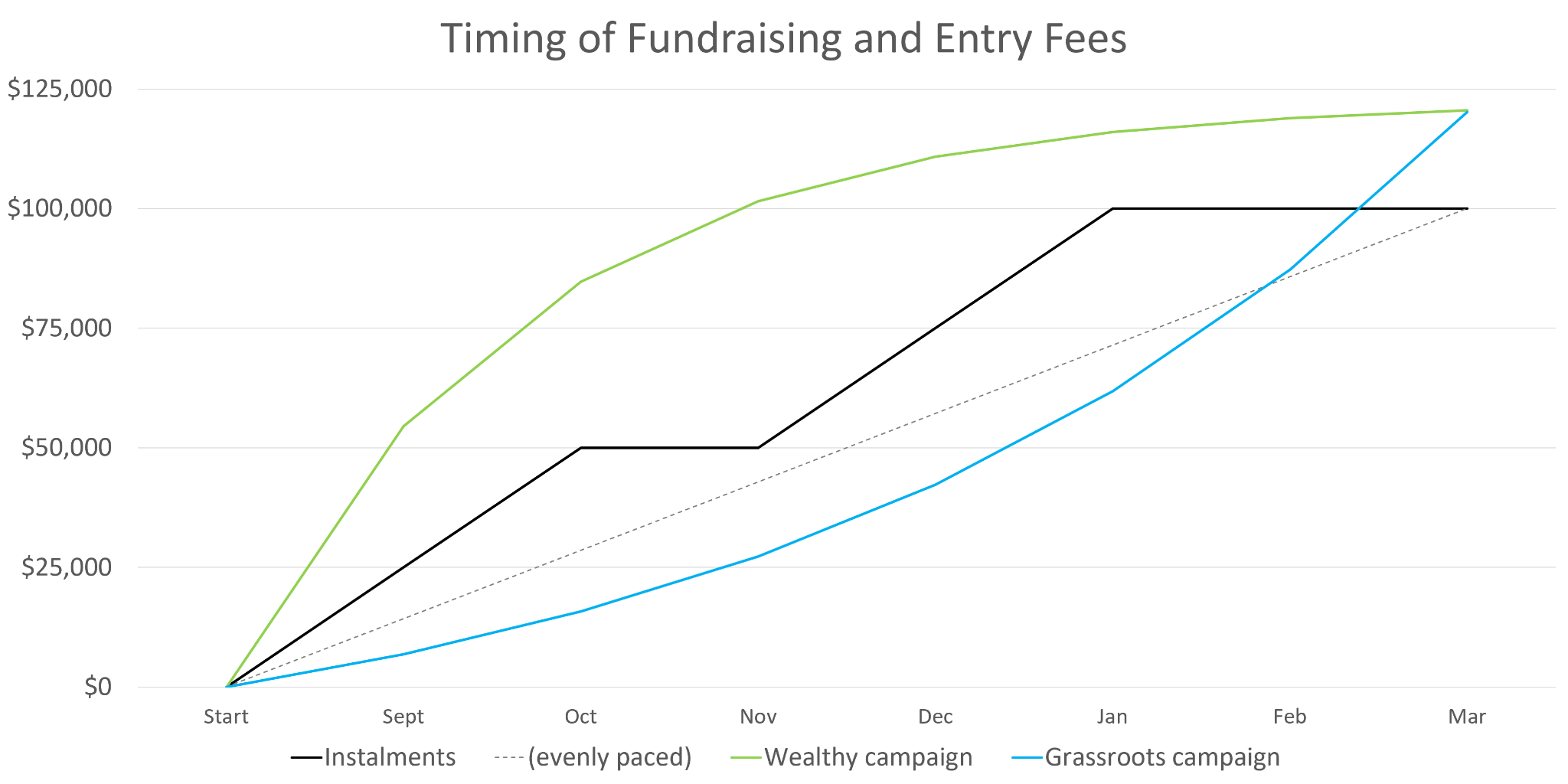
In the graph above, we can see how this might play out in the 2026 NDP leadership race. A wealthy campaign that raised a total of $120,000 would have no trouble meeting the required instalments, while a grassroots campaign on track to raise the same final amount would be kicked off the ballot by October.
So, even though “everyone pays the same fees”, what matters is timing. The aggressive instalment schedule favours campaigns that rely more on wealthy donors and self-donation.
Artificial scarcity
Donations are not unlimited. Every candidate wants to raise as much as possible, but their campaign’s abilities and resources are finite. Every member want to help their preferred candidate as much as possible, but their wallet is finite. So, for any given leadership race, there is some maximum amount that can be raised.
This pool of money is what collectively funds all spending by all candidates, including the payment of entry fees. With a higher entry fee, more of the pool is absorbed by the party, leaving less money for campaigning. This artificial scarcity has many negative side effects:
- Smaller candidate roster. The pool of money can only pay a certain number of entry fees. However, the cap is much lower than you might think. For example, a total fundraising pool of $1,000,000 could never pay ten entry fees, because each campaign also needs to pay real expenses, and because money isn’t divided evenly among the campaigns. Based on calculations from past leadership races, the $100,000 entry fee will likely cap this NDP leadership race to four or five confirmed candidates.
- Less diverse roster. The candidates that end up being excluded are more likely to come from marginalized groups, or to represent minority viewpoints, so the candidate roster ends up being less diverse.
- Less party-building. Scarcity increases the pressure on candidates to focus their time solely on fundraising, rather than “unprofitable” activities like building unity, learning from members, developing useful ideas to improve the party, and so on. Transactions replace interactions, and members feel like piggy banks rather than participants.
- Timid and pandering campaigns. When every dollar is crucial, candidates can’t afford to take risks. Sharing detailed ideas and plans is risky; making vague statements about “values” is safer. Addressing the concerns of marginalized people risks offending privileged members; fake “unity” and pandering to wealthy donors is safer.
- Less total fundraising. Higher entry fees can actually reduce total fundraising, even though they increase the short-term pressure to raise funds. Successful campaigns build through a “snowball effect”, where the campaign brings in new members, recruits those members to grow its outreach team, and repeats this process, constantly accelerating the pace of donations. However, when more of the early money is required for entry fees, this snowball effect is delayed. Just like compound interest, starting later means you lose the best weeks that would’ve happened late in the campaign.
- Hidden advantage for higher-dollar campaigns. Suppose one candidate raises $300,000 and another raises $200,000. Once they each pay the entry fee, their real campaign budgets will be $200,000 and $100,000. The first candidate had only a 3:2 advantage in support, but now gets a 2:1 spending advantage because of the entry fee.
The larger the entry fee, relative to the total pool of money, the worse these problems get.
Let’s compare the NDP’s 2025/26 contest with their 2017 contest. The number of donations in the year prior to the contest is down by 6.6%. However, the entry fee for this contest is 233% higher! This suggests the artficial scarcity effects will be quite strong in this contest.
Conclusion
A high entry fee corrupts and diminishes a leadership race by giving an unfair advantage to wealthier campaigns, by treating members unequally, by suppressing the voices of marginalized people, by encouraging timid and pandering campaigns, and by suppressing essential party-building activities in favour of fundraising. Ultimately, a leadership contest with high entry fees can never be democratic.
Supporters of the entry fee will continue to defend it by claiming it’s needed to test fundraising abilities, or to prevent frivolous candidates. Rebut these false arguments and supporters will fall back on the refrain that “members still have the final word”. But this is a red flag of quasi-democracy. When somebody promises you the “final word”, they’re admitting that somebody else had a say before you. The ballot that NDP members mark in the spring will be a curated ballot, distorted to suit the priorities of the wealthy and to sideline minority perspectives. ●
When the contest has ended, I’ll write a follow-up to test my claims against actual statistics from the race. In the meantime, why not check out my projection of the outcome?
 Saul Bottcher
Leave a comment