On March 29, Avi Lewis won the NDP leadership race with 56% support in the first round of voting.
This matches a projection I made on March 12, based on an analysis of donation statistics. But this should be no surprise, since donations strongly predict the outcome of leadership races, even when polling disagrees.
That’s because party leadership races are not democratic contests. They’re a clash between wealthy interests and grassroots members, with the odds in favour of wealthy interests.
The NDP is no exception. The contest rules were a subject of controversy among members, particularly the $100,000 entry fee and the degree of consultation with party members.
In September, shortly after the rules were announced, I claimed that the contest would not be democratic and named specific democratic deficits I expected would affect the race.
Now that the contest is over, we have the necessary data to confirm my prediction—the NDP leadership race was not democratic.
In this post, I’ll use public statistics to expose several serious democratic deficits. I’ll also touch on how the NDP could have prevented these problems, so that its leadership race would have had true democratic legitimacy.
Unequal ballot access
Each NDP leadership candidate had to raise $133,333* to secure their spot on the ballot.
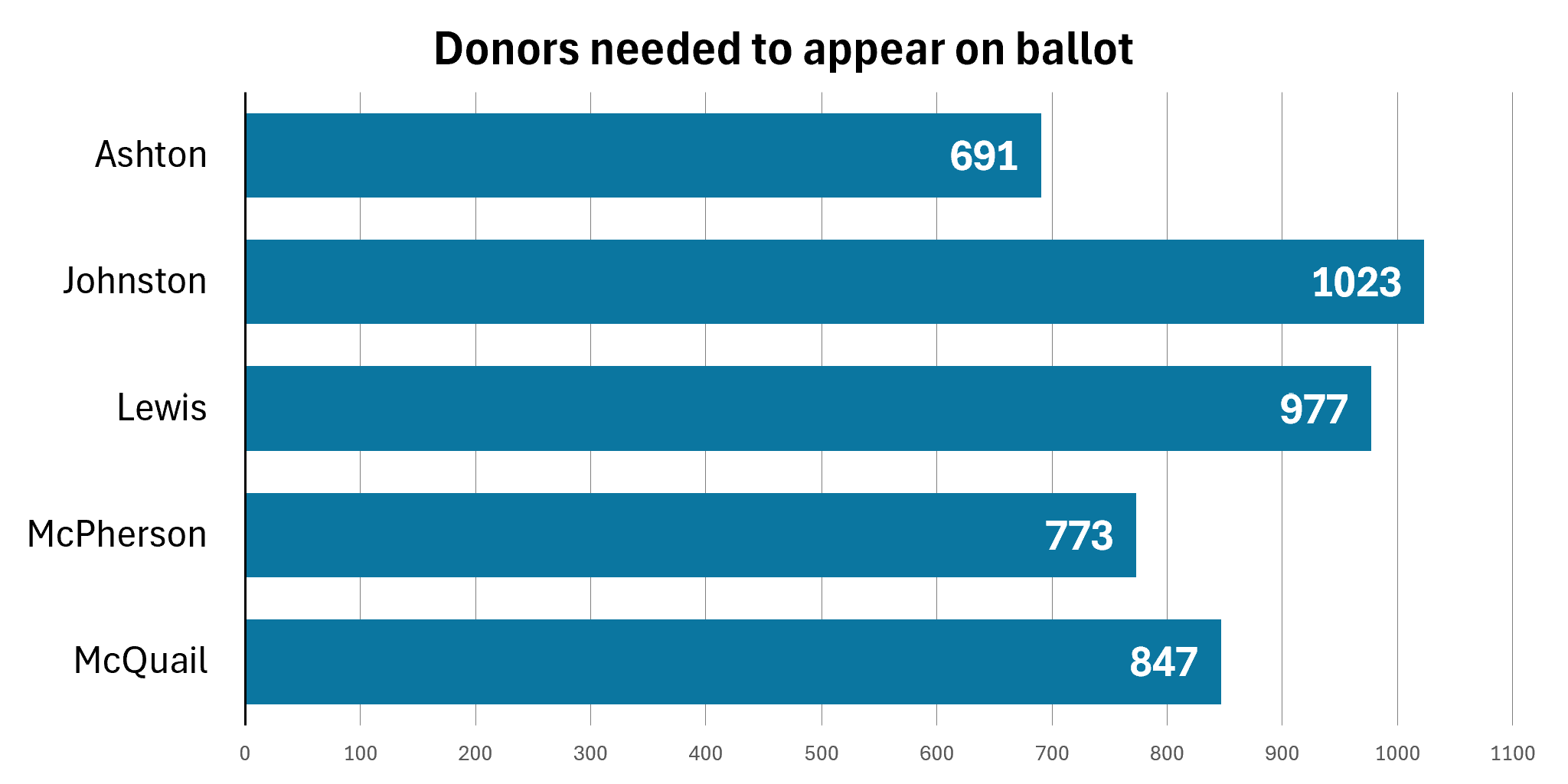
How many donors does it take to raise that much? That depends on how much money your donors can give! Different candidates are supported by people living in different economic circumstances, and because of this, access to the ballot is not equal:
| Candidate | To fundraise | $ / donor | Donors needed |
|---|---|---|---|
| ASHTON, Rob | $133,333 | $193.06 | 691 |
| JOHNSTON, Tanille | $133,333 | $130.31 | 1023 |
| LEWIS, Avi | $133,333 | $136.44 | 977 |
| MCPHERSON, Heather | $133,333 | $172.48 | 773 |
| MCQUAIL, Tony | $133,333 | $157.50 | 847 |
The reason this is a democratic deficit is not because it’s unfair to the candidates as individuals. Rather, it’s about equality between different groups of supporters. It’s undemocratic that some supporters should have to work much harder than others to get their preferred candidate on the ballot.
Two campaigns in particular highlight the inequality at work. Rob Ashton and Tanille Johnston had a similar number of donors (2028 vs. 1607) and received a similar number of votes (4193 vs. 5159). But, despite the similar size of the campaigns, the Ashton campaign needed only two thirds as many donors to get Ashton’s name on the ballot.
This problem could have been avoided, for example, by requiring a certain number of donors to get on the ballot, rather than a certain number of dollars. That way, support from people in different economic circumstances would be treated equally.
* Note: The publicly stated entry fee was $100,000, but in addition to the entry fee, the NDP also taxed donations at a rate of 25%. This means that a candidate actually needed to raise $133,333.33 of donations to be left with $100,000 after the tax.
Unequal use of personal funds
Contestants were allowed to donate to their own campaigns and to loan themselves money. Most candidates took advantage of these opportunities, but to very different degrees:
| Candidate | Self-loan | Self-donation | Tax | Net self-fund | Fees to fundraise |
|---|---|---|---|---|---|
| ASHTON, Rob | $0 | $2,850 | -$713 | $2,138 | $97,862 |
| JOHNSTON, Tanille | $0 | $1,750 | -$438 | $1,313 | $98,687 |
| LEWIS, Avi | $0 | $0 | $0 | $0 | $100,000 |
| MCPHERSON, Heather | $25,000 | $1,775 | -$444 | $26,331 | $73,669 |
| MCQUAIL, Tony | $10,000 | $1,651 | -$413 | $11,238 | $88,762 |
Although the entry fee was publicly stated as $100,000, the actual amount a candidate would need to raise through donations ranged from $73,669 to $100,000, depending on how much the candidate self-funded.
This is equivalent to a 36% penalty on candidates who did not self-fund. Given that the NDP had justified the entry fee as a test of fundraising ability, it’s clearly undemocratic to apply that test differently to each candidate.
More importantly, self-funding creates a loophole for wealthy candidates. It gives them a way to defer paying party taxes, since self-loans are not taxed. (The donations used to repay the loan will be taxed, but that happens later.) It also allows a candidate to further reduce the number of donors they need to get on the ballot.
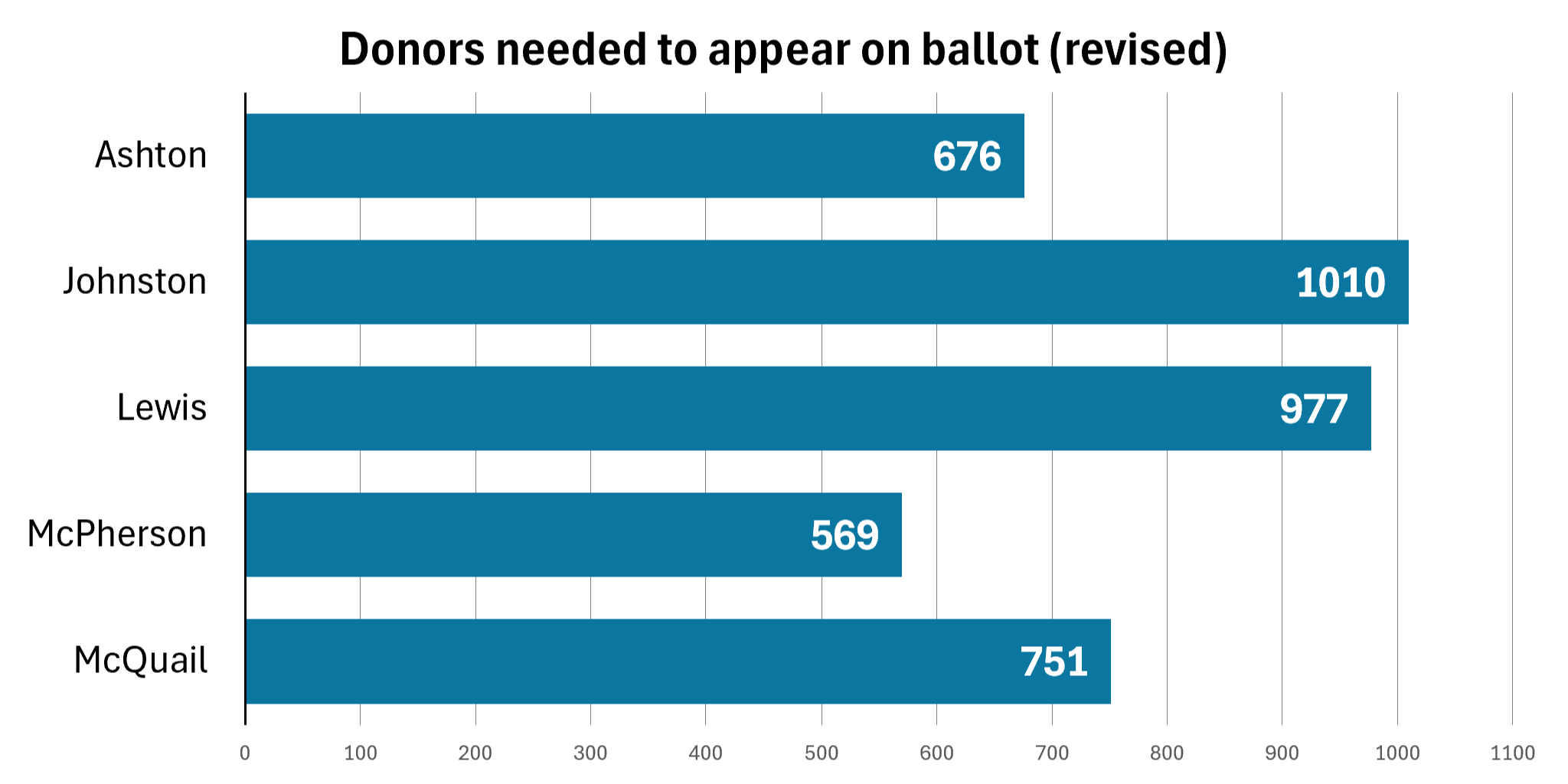
Let’s recalculate how many donors each candidate needed to get on the ballot, taking self-funding into account:
| Candidate | Fees to pay | To fundraise | $ per donor | Donors needed |
|---|---|---|---|---|
| ASHTON, Rob | $97,862 | $130,483 | $193.06 | 676 |
| JOHNSTON, Tanille | $98,687 | $131,583 | $130.31 | 1010 |
| LEWIS, Avi | $100,000 | $133,333 | $136.44 | 977 |
| MCPHERSON, Heather | $73,669 | $98,225 | $172.48 | 569 |
| MCQUAIL, Tony | $88,762 | $118,349 | $157.50 | 751 |
Here we see an even worse level of inequality. Heather McPherson, who loaned and donated a total of almost $26,775 to her own campaign, needed only 569 donors to get on the ballot, while Tanille Johnston, who donated $1750 to her own campaign, needed 1010 donors.
As a percentage, Johnston needed the support of 78% more donors than McPherson to gain access to the ballot.
This additional democratic deficit could have been avoided simply by banning candidates from giving donations or loans to their own campaigns.
Small campaign suppression
The entry fee is similar to a poll tax. It’s a regressive measure that penalizes smaller campaigns, taking most of the funds they raise and leaving them with little to actually spend on campaigning.
Here’s how much each campaign was able to spend, after paying all fees:
| Candidate | After-tax funds | Entry fee | Real budget | % to fees | % to campaign |
|---|---|---|---|---|---|
| ASHTON, Rob | $295,778 | $100,000 | $195,778 | 34% | 66% |
| JOHNSTON, Tanille | $161,364 | $100,000 | $61,364 | 62% | 38% |
| LEWIS, Avi | $1,084,277 | $100,000 | $984,277 | 9% | 91% |
| MCPHERSON, Heather | $551,664 | $100,000 | $451,664 | 18% | 82% |
| MCQUAIL, Tony | $103,848 | $100,000 | $3,848 | 96% | 4% |
There’s a drastic difference here in spending power. While the Lewis campaign was able to spend 91% of its total funds on campaigning, the Johnston campaign could only spend 36% of their funds, and the McQuail campaign only 4%.
Some people would argue that there’s nothing unfair here, since every campaign paid the same entry fee. But as I said above, democracy is not based on equality between campaigns, it’s based on equal representation for each member.
From that perspective, if you were an NDP member and you supported one of these candidates with an average donation, here’s how much of your money they were actually able to spend on their campaign:
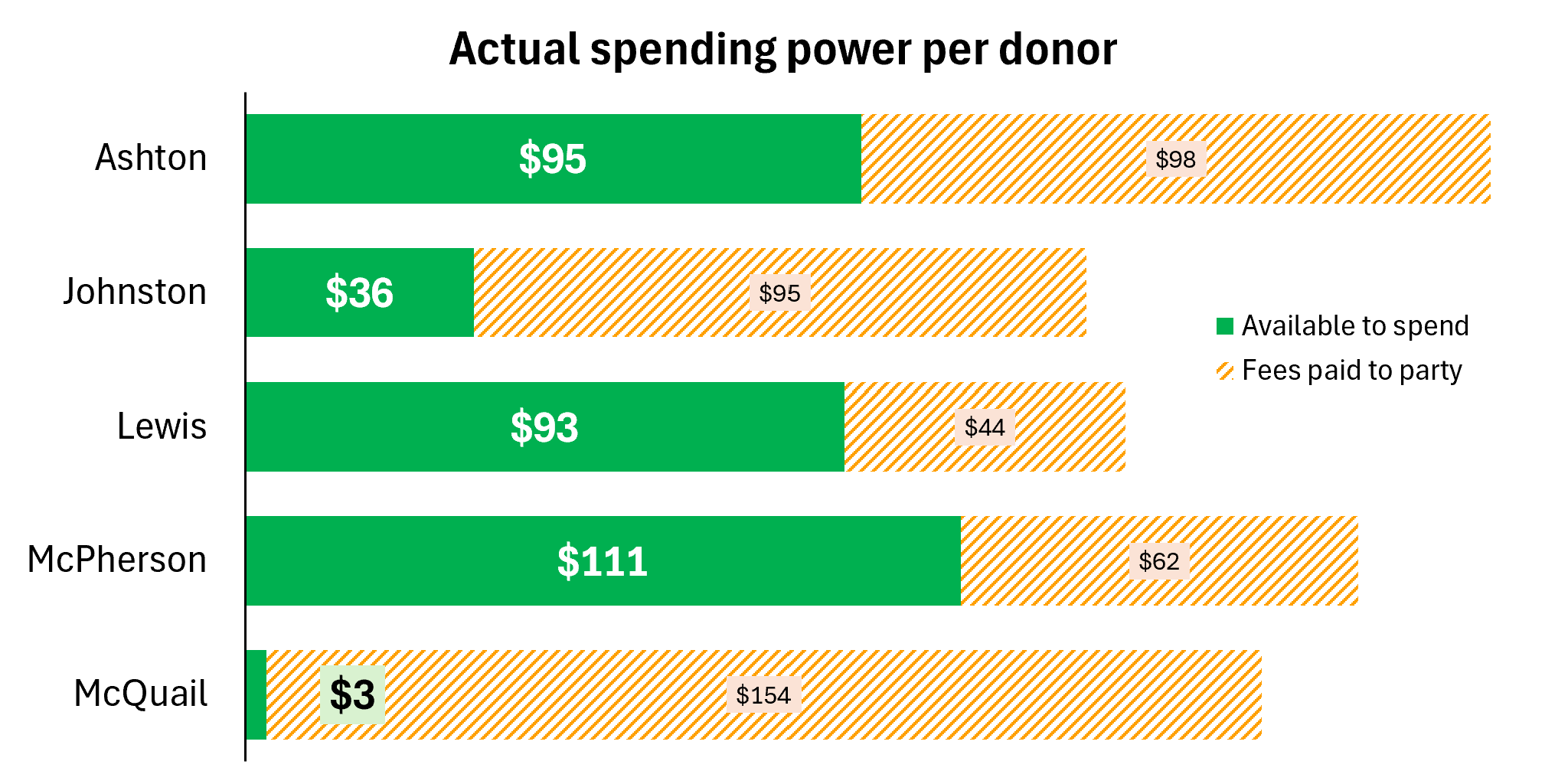
Let’s compare Avi Lewis and Tanille Johnston, the two candidates whose donors gave the most similar amounts ($137 and $130 on average). Despite these similar donations, each donor who supported Lewis generated $93 of campaign spending power, while each donor who supported Johnston only generated $36 of spending power.
At the extremes, we have McPherson donors each generating $111 of spending power, while McQuail donors each generated only a measly $3. In other words, to generate the spending power of one McPherson donor, McQuail’s campaign would need thirty-three donors.
If a campaign could grow solely through word of mouth, these differences might not matter. But in reality, leadership campaigns don’t achieve broad appeal without significant spending. Travel, events, websites, and printed materials all cost money.
The Johnston and McQuail campaigns received meaningful support from party members, but weren’t given an equal opportunity to grow their reach. Or, to word it more plainly: their campaign growth and final vote totals were suppressed.
Once again, this democratic deficit could have been avoided with different contest rules. For example, if the entry fees had been collected gradually through the 25% tax, instead of through the accelerated instalments set by the party, the smaller campaigns would have had more spending power early in the contest, bringing overall spending power closer to an equal footing.
Estimating campaign budgets
By combining the data we have for self-contributions, loans, fundraising, and fee deadlines, we can estimate how much real spending room each campaign had on a day-to-day basis:
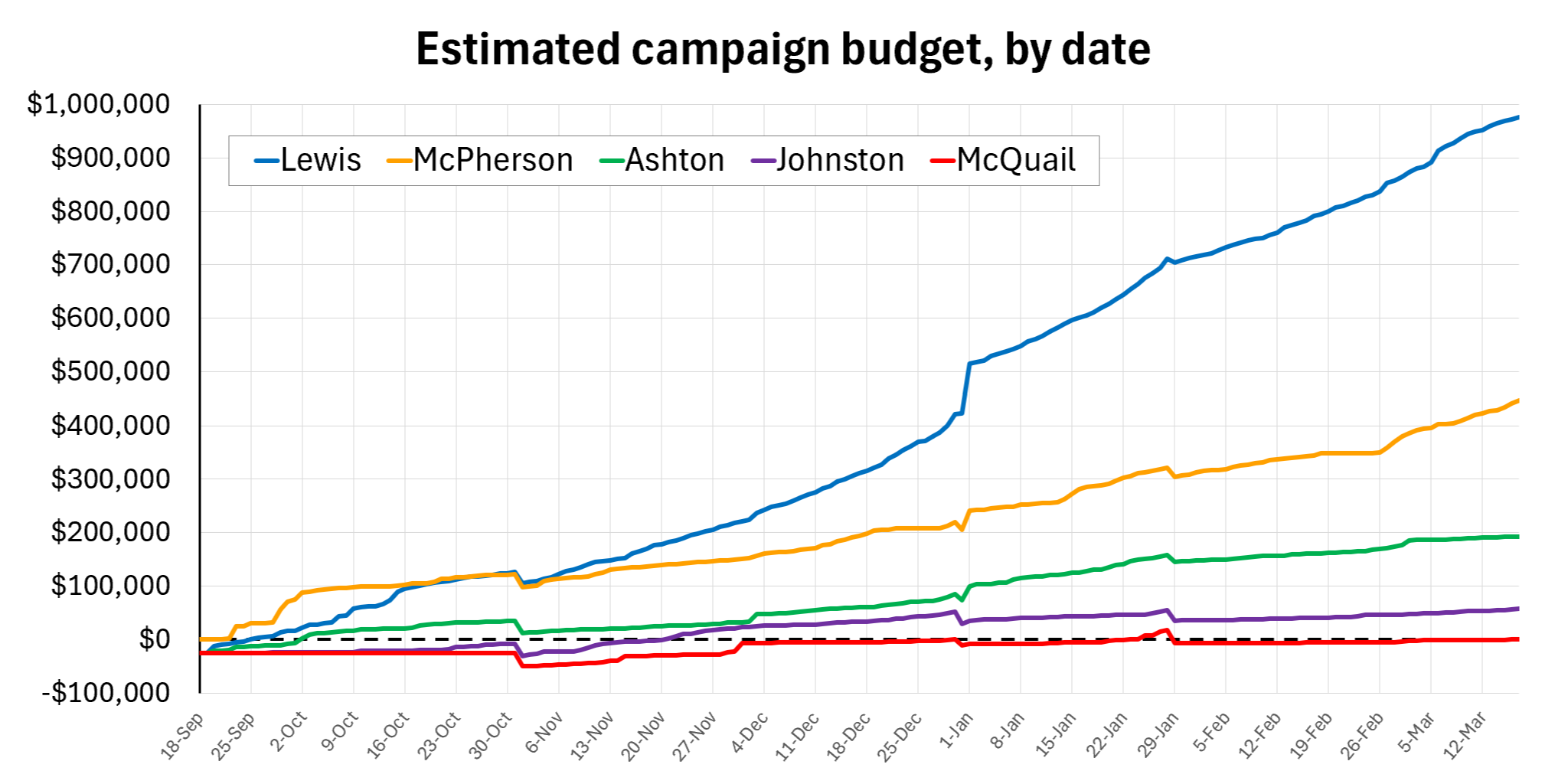
In this graph, we can visualize several of the points made earlier in this post: the McPherson campaign’s head start thanks to a $25,000 self-loan; the Lewis campaign’s exponential growth (spending money to raise money); the constraints facing the Johnston campaign in the first half as most of their budget was absorbed by fees; and the effective disenfranchisement of McQuail’s supporters.
Other democratic deficits
In my post from September, I predicted we would see several other democratic deficits. These other predictions can’t be firmly proven or disproven without more data, but we can make a few observations:
I claimed that the size of the candidate roster would effectively be capped at four or five candidates. Ultimately, there were five.
I claimed that the candidate roster would be less representative of the Canadian population. Although two of the five candidates were women, and one candidate was Indigenous, there were no visible minority candidates, and there were three candidates from BC (an excess) but only one from Ontario and none from Québec (both shortfalls).
I also claimed that total fundraising and party-building would be limited, because the entry fee would absorb money that could have gone to outreach. We can get a bit of insight here by comparing the 2017 and 2026 contests (all figures in 2026 dollars):
| Year | Raised | (Per candidate) | Fees paid | To spend |
|---|---|---|---|---|
| 2017 | $2,486,193 | (4 @ $621,548 ea.) | $775,040 | $1,711,153 |
| 2026 | $2,870,549 | (5 @ $574,110 ea.) | $1,217,637 | $1,652,911 |
We can see that in 2026, with a higher entry fee, there was about $50,000 less fundraising per campaign, and 6% less money available to spend overall. Had there been a lower entry fee, and thus more money available for outreach, candidates could have raised more for the party—or spent more time engaging members on important issues.
Finally, I predicted that the campaigning would be timid. Obviously, this is subjective, and would be driven by other factors in addition to the rules. But there appears to be a broad consensus that the leadership race was boring and only superficially addressed the NDP’s internal debates.
Conclusion
The 2026 NDP leadership race was not democratic. Its shortcomings included unequal ballot access, personal wealth affecting the contest outcome, suppression of small campaigns, and likely other democratic deficits as well.
If you’re an NDP member, it’s tempting to dismiss these concerns now that the contest is over, especially with the result being so decisive. But what if the next leadership race has an outcome that isn’t so decisive? What if the result is 51% to 49%, and the winning candidate has heavily exploited the loopholes mentioned in this post? Will that be healthy for the party?
Democratic legitimacy is like fire safety: most of the time it feels abstract and tedious, until the day you need it. Then you wish you’d paid it more attention earlier.
In Avi Lewis, NDP members have chosen a leader who supports democratic reform in our federal elections—will he support it in his own party? NDP members should press Lewis to endorse deep reforms to leadership contest rules, so that next time around, the NDP can achieve a Canadian first: a leadership race that is truly democratic. ●
What exactly would a democratic leadership race look like? In an upcoming post, I’ll outline the minimum standard our political parties should meet, and sketch a vision for how they could go even further.
 Saul Bottcher
Leave a comment