In an earlier post, I reported that the Green Party of Canada had taken the unusual measure of adding partisan commentary directly on its ballots for this year’s pre-convention voting.
The pre-convention vote has now been tallied, and the results closely match the partisan ballot comments. How should this be interpreted?
The vote results
The images below show the convention proposals, ranked by the number of votes they received. (The purpose of the pre-convention vote was to prioritize proposals for consideration at the convention. The first fifteen proposals in each of two categories will be considered by the convention attendees, in the order shown. Proposals below that cutoff are essentially vetoed, since they will not be considered.)
The colour-coded column indicates whether the partisan ballot comments for that proposal were primarily positive, negative, or mixed.
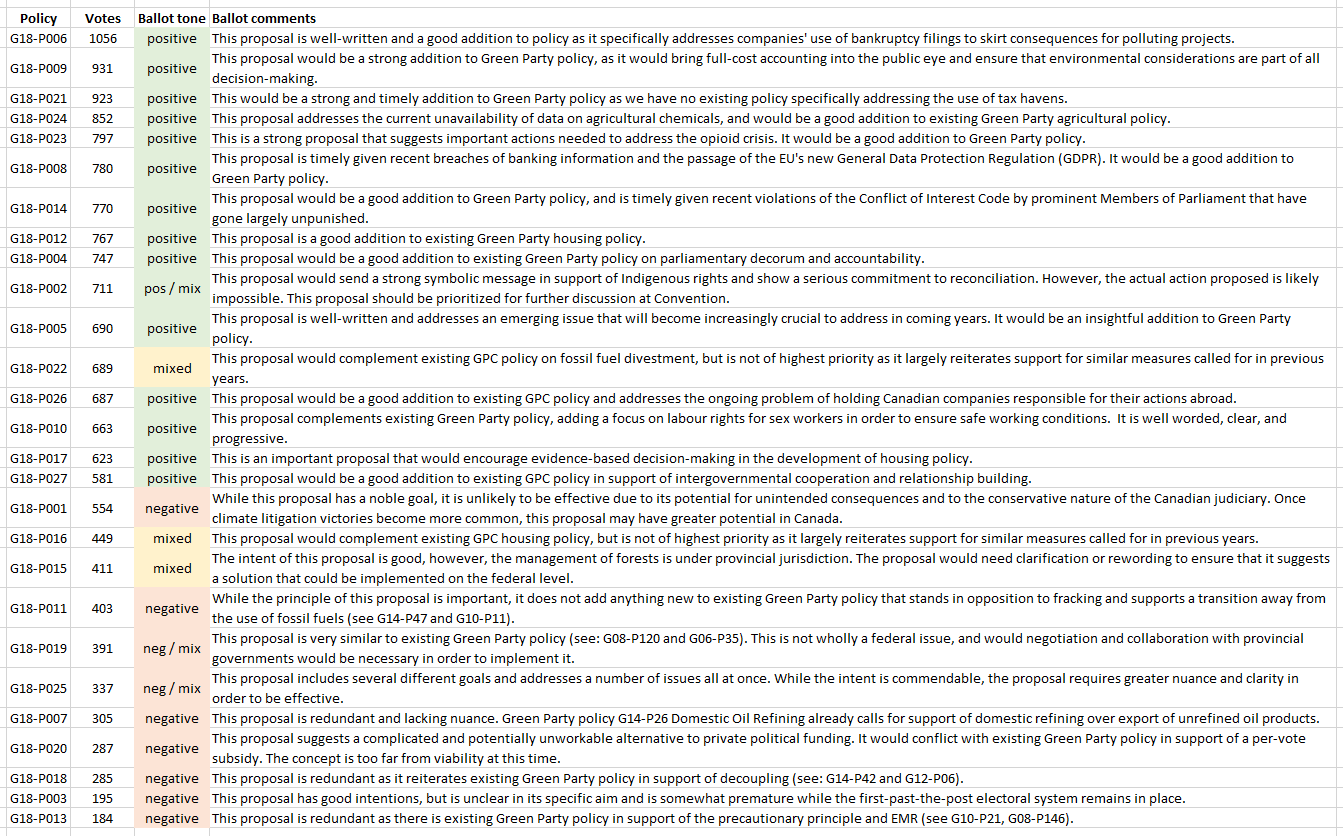
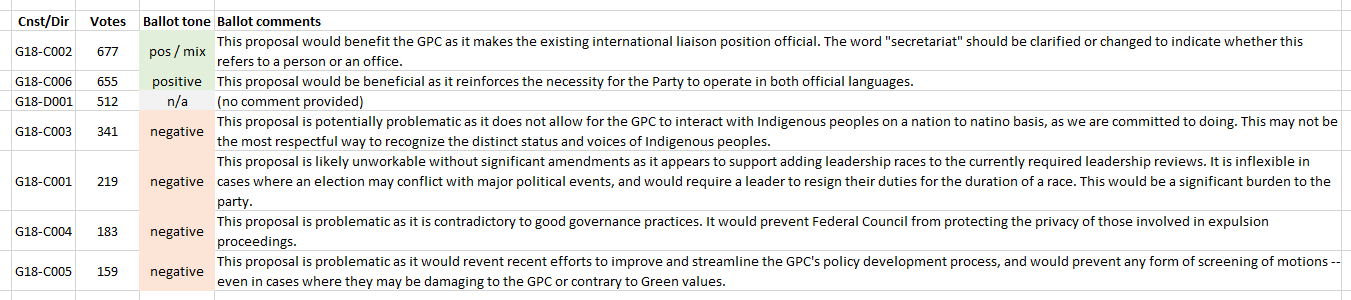
With only a few exceptions, the proposals which carried positive partisan comments received more votes than those which carried mixed comments, which in turn received more votes than the proposals which carried negative partisan comments.
How should these results be interpreted?
There are two possible interpretations of these results:
- The partisan comments have distorted the vote.
- No members were swayed by any of the partisan comments; the vote results matched the partisan comments by sheer coincidence.
The second scenario seems very unlikely. However, as much as common sense might suggest the vote was distorted, from a perspective of statistical evidence, the results shown above are neither a proof nor a disproof, only a correlation.
Why this ambiguity is a problem
Usually, we say that strong evidence comes from controlled and repeatable experiments. But a vote, by its very nature, is a one-time event that involves a set group of participants. There is no way to repeat a vote, nor any (ethical) way to create a “control group”.
This makes it impossible to gather the sort of hard evidence that might conclusively settle the question of whether a vote was distorted or clean. All we have is correlations and circumstantial evidence.
At the same time, it is easy to interpret that circumstantial evidence as proof of a distorted vote.
In other words, the Green Party has created a situation where it is easy for a voting member to believe that the process is tainted, and impossible to prove that it is not. That is a toxic mix.
(Picture a member who is passionate about their proposal and has invested time and energy in craft and promoting it. Imagine their proposal receives a negative comment, especially one which they feel is unfair. Imagine that it also receives a negative vote that excludes it from consideration at the convention.
Will this person be satisfied with the fairness of the system, as they perceive it? Or will tension arise?)
The results of the convention vote, and any context surrounding that vote, will provide more insight. I will report on this situation again after the party’s convention in September.
(Edited 2018 August 30: improved the wording of the second scenario thanks to a comment from Arleigh Luckett. The original wording used the word “ignored”, which suggested that members either did not read the comments, or were influenced, ignoring the possibility that the comments were read and disregarded.)


 Saul Bottcher
Leave a comment