Since 2007, the Green Party of Canada has experienced a severe decrease in contributions to its EDAs (riding associations), with the losses now totaling more than 80% of both dollars and contributors. The trend has remained negative through 2017.
(This post is the first part of Decade of Decline, my 2018 report detailing the collapse of grassroots support for the Green Party of Canada. For a table of contents, please see the Introduction.)
(Update 2021: Greens Fail to Nominate Full Slate; up to $1,000,000 of Public Funding at Risk)
(Update 2022: The Green Party of Canada has lost 11,000 Members)
(Update 2025: The Green Party of Canada is Dead—And That’s Okay)
The decline in dollars raised by Green Party EDAs
Chart 1.1.1 below shows the total dollar amount of contributions received by Green Party EDAs in each year. The total is given both including and excluding the EDA in Saanich—Gulf Islands. (Please see the Introduction for an explanation of how certain outliers are handled in this report.)
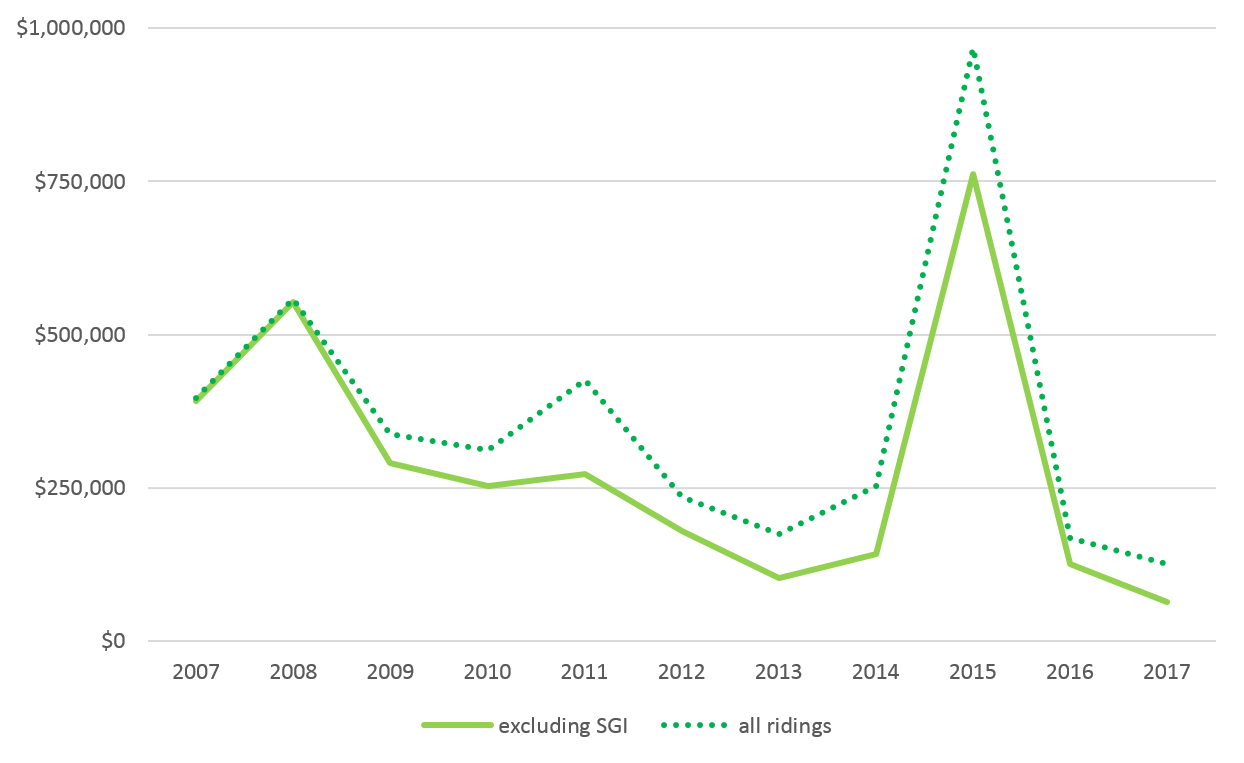
Aside from the spike in 2015, the trend is strongly negative since 2007. The total dollar amounts contributed to GPC EDAs in 2016 and 2017 are the lowest on record with Elections Canada (whose records date back to 2004).
Since 2007, the dollar amount of contributions to GPC EDAs has declined by 68%. With Saanich—Gulf Islands excluded, the dollar amount of contributions to all other GPC EDAs has declined by 84%.
The decline in number of contributors to Green Party EDAs
Chart 1.1.2 below shows the total number of contributors to all Green Party EDAs for each year. The total is given both with and without the riding of Saanich—Gulf Islands.
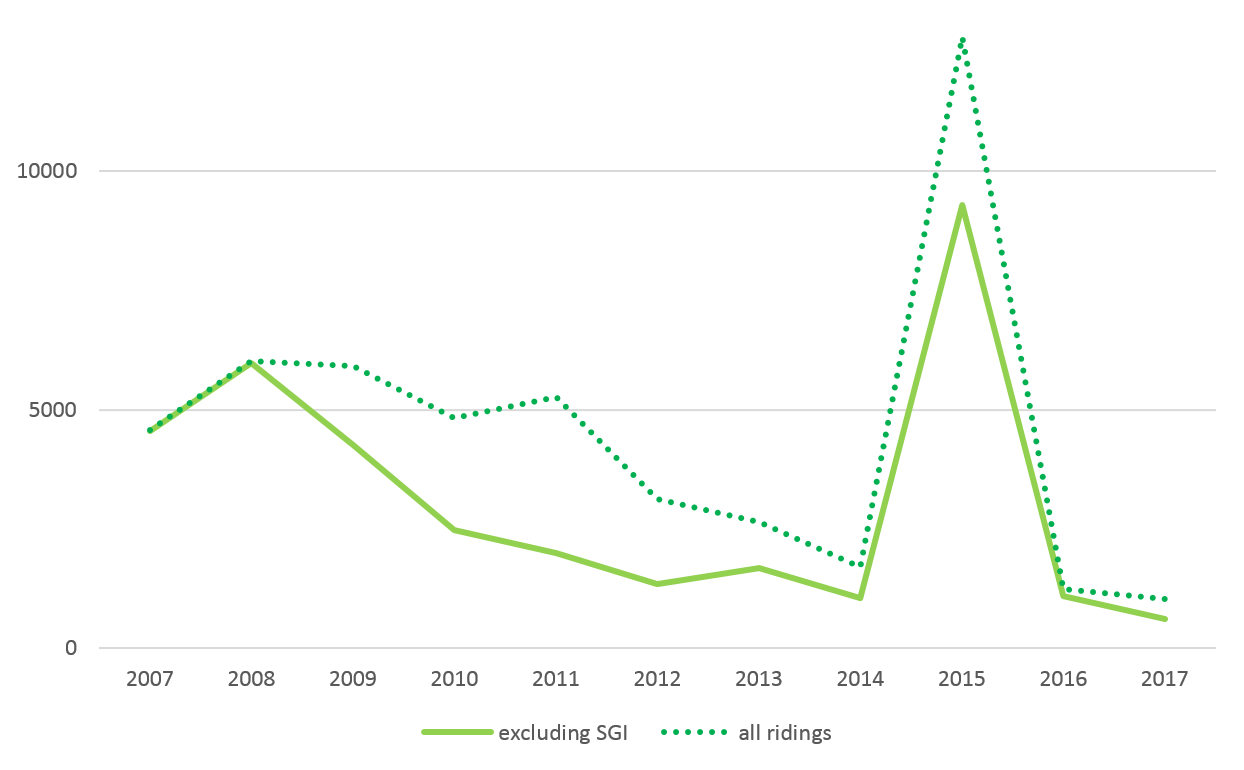
Again, outside of the spike seen in the 2015 election, the trend is strongly negative since 2007. The number of contributors in the years 2016 and 2017 are the lowest on record with Elections Canada (whose records date back to 2004).
Since 2007, the total number of contributors to GPC EDAs has declined by 77%. With Saanich—Gulf Islands excluded, the total number of contributors to all other EDAs has declined by 87%.
Declines in other major parties
By examining data for the Liberals, Conservatives, NDP, and Bloc Québécois, we can compile a list of significant drops in grassroots contributions experienced by other major parties. In every case, these drops correspond with scandals, major election defeats, or internal disarray. The list is as follows, from least damaging to most damaging:
- In the 2011 election, the Liberal party experienced the worst defeat of its long history, falling to third-party status. Leader Michael Ignatieff subsequently resigned. During this period, the dollar amounts contributed to Liberal EDAs declined by 42% and the number of contributors declined by 11%.
- During the period leading up to and during the 2011 election, the Conservative party was at the center of a crisis of democracy. The party made unprecedented use of prorogation; saw its Cabinet found in contempt of Parliament (a first throughout the entire Commonwealth); had charges laid against it by Elections Canada; and was implicated in the robocall scandal. During this period, dollar amounts contributed to Conservative EDAs declined by 16% and the number of contributors declined by 44%.
- In the 2015 election, the NDP suffered a loss of 59 seats (more than half of its seats), falling back to third place. Following the election, a controversy over the party’s direction and leadership led to the unexpected removal of leader Thomas Mulcair. During this time, dollars amounts contributed to NDP EDAs declined by 37% and the number of contributors declined by 49%.
- During the same 2015 election, the Conservative party, having finally achieved majority status in 2011, was soundly defeated by the rival Liberals, after having waged an election campaign that inflamed the anger of centrist and progressive voters across the country. Party leader Stephen Harper, the architect of the party’s past decade of dominance, retired immediately. Following these events, dollar amounts contributed to Conservative EDAs declined by 54% and the number of contributors declined by 41%.
- Leading up to the 2006 election, the Liberal party was implicated in the Sponsorship Scandal. They went on to lose 30 seats in the election, ending 13 consecutive years of Liberal government, and marking the ascendancy of the Conservative party, which lasted for the next decade. Following this election, leader Paul Martin resigned. During this period, dollar amounts contributed to Liberal EDAs declined by 49% and the number of contributors declined by 47%.
None of the declines on this list involves a loss of more than 55% of dollar amounts contributed or 50% of contributors. The Green Party’s losses total 68%/77%, or outside of Saanich—Gulf Islands, 84%/87%.
Despite Canada’s biggest political defeats and scandals of the past 15 years being on this list, the Green Party’s losses since 2007 are between one-and-a-half to three times the magnitude of the losses described above.
The lesson of the Bloc Québécois
However, the list above is incomplete. I have intentionally held back the one example which is similar to the decline of the Green Party in its magnitude and duration. Namely, the ongoing 10-year decline of the Bloc Québécois, which unfolded as follows:
- Starting in 2008, the party went through a period of internal chaos and severe losses. This began when they lost 44 of their 47 seats, and as a result, their official party status. Leader Gilles Duceppe subsequently resigned.
- Their next leader, Daniel Paillé, served for two years, then had to resign for health reasons. He was succeeded by controversial leader Mario Beaulieu, during whose term several Bloc MP’s defected or resigned.
- Duceppe returned for the 2015 election, with Beaulieu remaining as party President. Despite earning ten seats, the party’s popular vote fell to its lowest point ever (19% within Québec), and Duceppe resigned again.
- The term of the next leader, Martine Ouellet, was surrounded by controversy, and the party’s members split into two camps. The struggle culminated in a mass defection of seven of the party’s ten MP’s. A letter signed by more than twenty former Bloc MP’s, including Duceppe, supported the defectors, and Ouellet ultimately resigned in 2018.
- As of August 2018, the Bloc has embarked on a project to completely reinvent itself in time for the 2019 election. However, despite reconciliation efforts and Ouellet’s resignation, five of the seven defectors have not returned. Some party members consider attempting a reinvention program so close to an election “suicide”, and question whether the Bloc will survive the 2019 election. [Edit: as of September 2018, the remaining five defectors have finally returned to the Bloc.]
During the events described above, dollar amounts contributed to Bloc Québécois EDAs dropped by 89% and the number of contributors dropped by 90%. These losses are only 5 and 3 percentage points greater in magnitude than the Green Party’s losses outside of Saanich—Gulf Islands since 2007.
Comparing the Bloc and the Greens
Chart 1.1.3 below compares the decline of dollar amounts contributed to Bloc Québécois and Green Party EDAs. As before, the Green Party statistics are given both with and without Saanich—Gulf Islands. To allow for a clear comparison, the vertical axis shows the amounts contributed as a percentage of each party’s average from 2004-2017 (the full span of Elections Canada data).
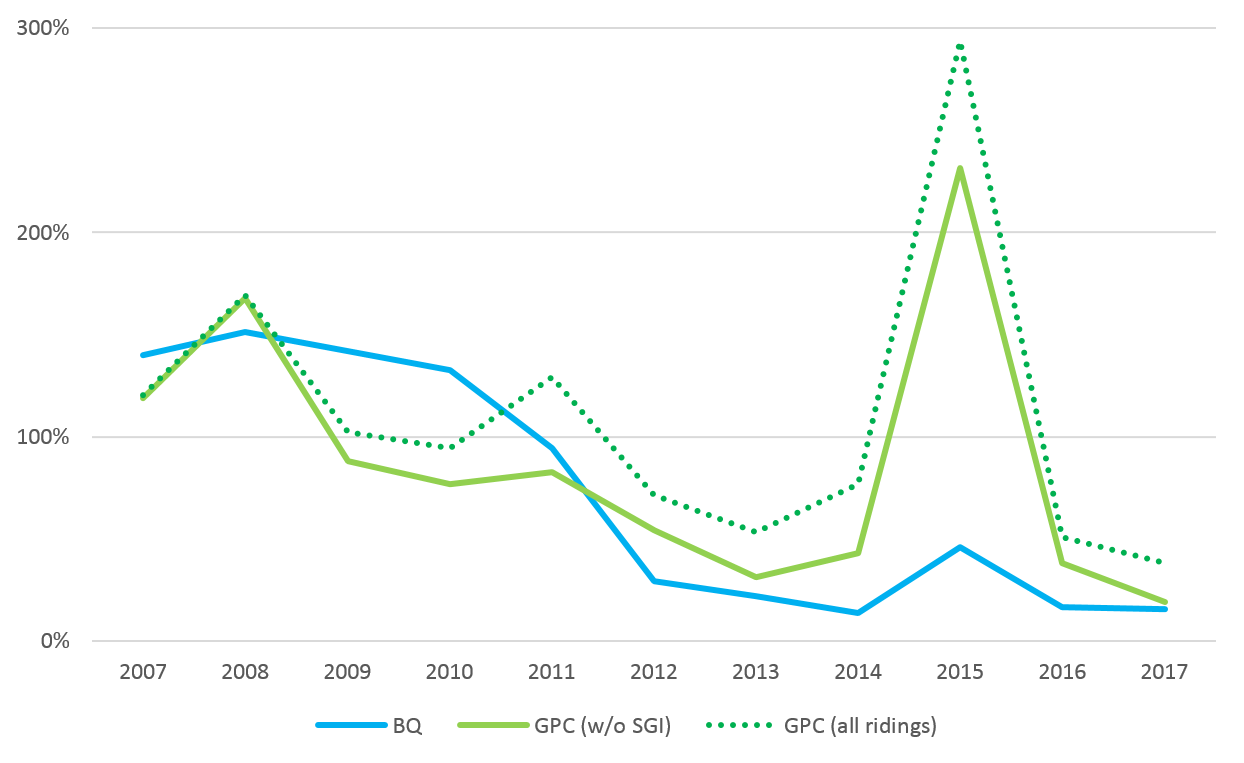
The trends are comparable, with the main difference being larger election spikes for the Green Party, particularly in 2015.
Chart 1.1.4 below compares the decline in the number of contributors to Bloc Québécois and Green Party EDAs. Again, to allow for easy comparison, each party’s number of contributors is given as a percentage of that party’s average from 2004-2017.
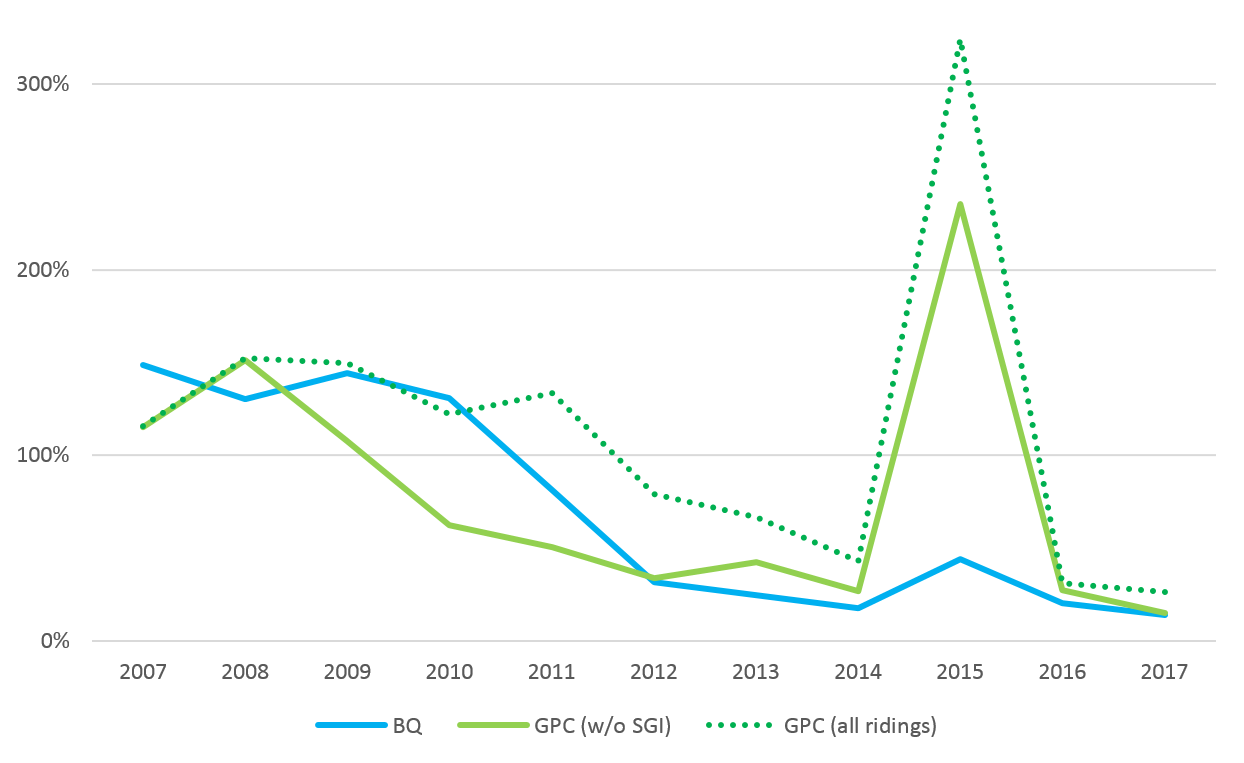
As with Chart 1.1.3, the trends are similar in both duration and magnitude, with the Green Party experiencing a larger spike in the 2015 election.
Upward trends in major parties
We have compared the Green Party’s decline to the most serious declines in other parties. But what about upward trends?
In the 15 years of data available, there are only two significant upward trends in other major parties:
- From the year 2004 to 2011, the new Conservative party was formed with Stephen Harper as its leader, and won consecutive elections in 2006, 2008, and 2011. During this period, the Conservatives increased the dollar amounts contributed to their EDAs by 118% and the number of contributors also by 118%. (This is equivalent to recovering from a loss of 54% of both dollar amounts and contributors.)
- In 2013, Justin Trudeau was elected leader of the Liberal Party, and led them to a historic comeback from third place to majority government. During this time, the Liberals increased the dollar amounts contributed to their EDAs by 156% and the number of contributors by 38%. (This is equivalent to recovering from a loss of 61% of dollars and 28% of contributors.)
In other words, to reverse the Green Party’s decline of EDA-level contributions would require an event of greater impact than Justin Trudeau’s Liberal revival or Stephen Harper’s decade of Conservative dominance.
Another important point to consider when looking at the list of declines and upward trends is that, in Canadian federal politics, serious declines appear to be more numerous and happen more quickly than growth. Building a federal party is a slow process and invariably involves setbacks.
The Liberal revival is the only example in the past 15 years of a party making such a rapid recovery, and it was achieved by a party with an extremely long history and well-established support base. (And, again, it would take an event with almost double the impact of this Liberal revival to fully recover the Green Party’s losses since 2007.)
Normal fluctuations in major parties
Having examined declines and upward trends, we can round out the picture by making some general observations about EDA contributions outside of these periods.
For the three major parties, outside of the crisis and growth periods listed above, no decrease in EDA contributions has lasted longer than two years, nor involved a loss of more than 25% of the party’s average contributions.
Phrased another way, the decline of the Green Party is five times longer in duration, and three-to-four times deeper in its effects, than any normal up-and-down fluctuations that major parties usually experience.
A final perspective: the Green share of the pie
We have already examined Green Party EDA contributions over time, compared them to the declines and growth periods of other major parties, and compared them in detail with the misfortunes of the Bloc Québécois.
Chart 1.1.5 presents one final perspective, which is the Green Party’s percentage share of dollars contributed to EDAs of the five major parties. This perspective compensates for election-year spikes (when all parties typically raise more money), longer-term political trends (such as a shift toward or away from EDA’s as a fundraising tool), and currency inflation, allowing us to measure party-vs-party performance.
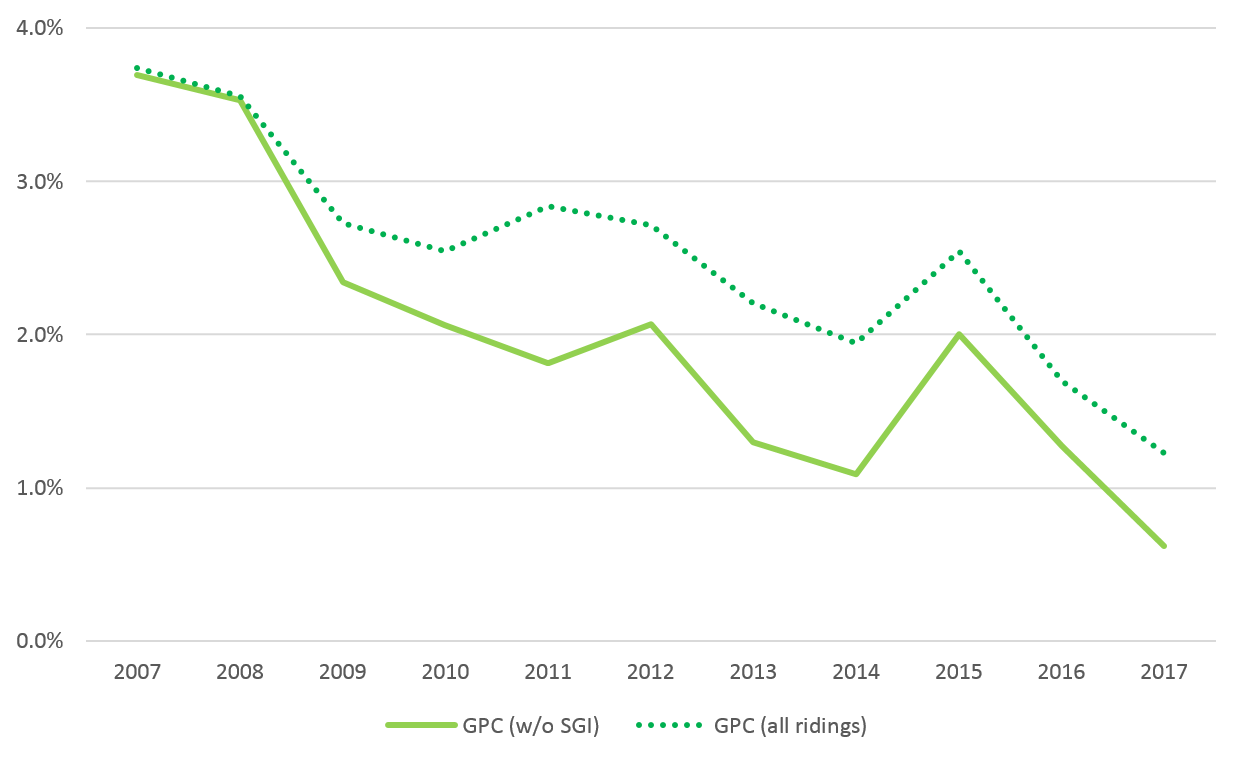
We can see that a bump is still present in 2015, indicating that although all parties experienced historic dollar amounts contributed to their EDAs that year, the Green Party increased its amounts contributed more than the other parties did.
However, that is the only bright spot on the chart. The downward trend from 2007 to 2017 is unmistakable and relentless. The Green Party began the decade with its EDAs receiving 3.7% of all dollars contributed to EDAs of the five major parties. It ended the decade capturing only 1.2% of those dollars, a drop of two thirds. Outside of Saanich—Gulf Islands it captured only 0.6% of those dollars, a drop of five-sixths.
Chart 1.1.6 applies the same lens to EDA contributors. The chart shows the number of contributors to Green Party EDAs each year as a percentage of the total number of contributors to EDAs of the five major parties.
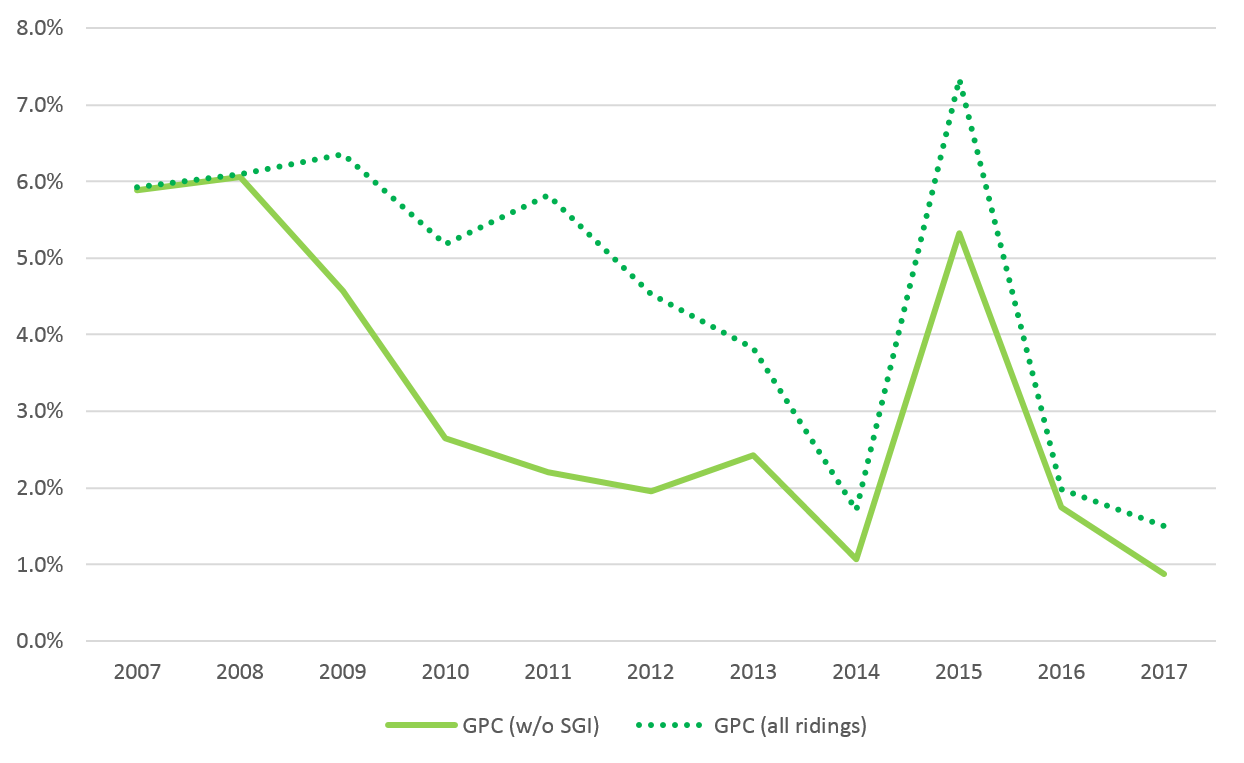
Again, 2015 is a bright spot. With the EDA in Saanich—Gulf Islands included, it was the party’s best year relative to the performance of other parties. With the EDA in Saanich—Gulf Islands excluded, it was the party’s third-best year, closely behind 2007 and 2008.
However, there is the same unmistakable downward trend. The Green Party began the decade with 5.9% of all contributors to major party EDAs in 2008.
That percentage rose to 6.4% in 2009 if the EDA in Saanich—Gulf Islands is included, but had already fallen to 4.6% if SGI is excluded.
By 2017 only 1.5% of contributors to major party EDAs were contributing to the GPC, a drop of three-quarters since 2009. Excluding Saanich—Gulf Islands, the percentage was even lower at 0.9%, a drop of four-fifths since 2008.
Summary
Since 2007, the Green Party has experienced a deep and prolonged decline in EDA contributions, with losses between 68–87%. This decline is visible in the absolute number of dollars and contributors, and also relative to the performance of other parties. Outside the single outlier riding of Saanich—Gulf Islands, the Green Party’s decline is even more profound, and involves a loss of more than 80% of both dollars and contributors.
No major party has undergone a decline more than half as severe in the past 15 years, with the exception of the Bloc Québécois. The decline in the Bloc is similar in both duration and depth, and has culminated in an existential crisis for that party, with some observers suggesting the Bloc may not survive the 2019 election.
A comeback proportional to the one the Liberals achieved leading up to the 2015 election—widely seen as one of the greatest comebacks in Canadian political history—would serve to recover only half of the losses experienced by the Green Party over the past decade.
The downward trend has continued through 2017, with the years 2016-17 being the worst on record with Elections Canada.
Coming next
Part 1.2 has been published. It examines the declining number of active EDAs, the increase of “paper EDAs”, and the erosion of the party’s core of well-established EDAs.
[Edit 2018-Sep-11: Several changes were made to improve this post. All charts and comparisons were adjusted to begin with 2007 instead of 2008, so that the window of comparison would both begin and end on a non-election year. (This did not impact any of the post’s overall conclusions.) Charts 1.1.5 and 1.1.6 were added to provide an additional perspective on the fundraising decline. Wording was improved in several places to be more clear and more specific, without changing the meaning of the text or the claims being made.]
[Edit 2018-Sep-24: Additional improvements were made. Terminology was standardized to “dollar amounts contributed” and “number of contributors” for clarity. Captions were added to all graphs. The data set was upgraded to correct errors that GPC EDAs had made when filing their financial statements. None of these improvements affected the overall conclusions of this post.]
[Edit 2018-Sep-26: Changed title from “collapse of local fundraising” to “collapse of local contributions” for better accuracy.]


Leave a comment